
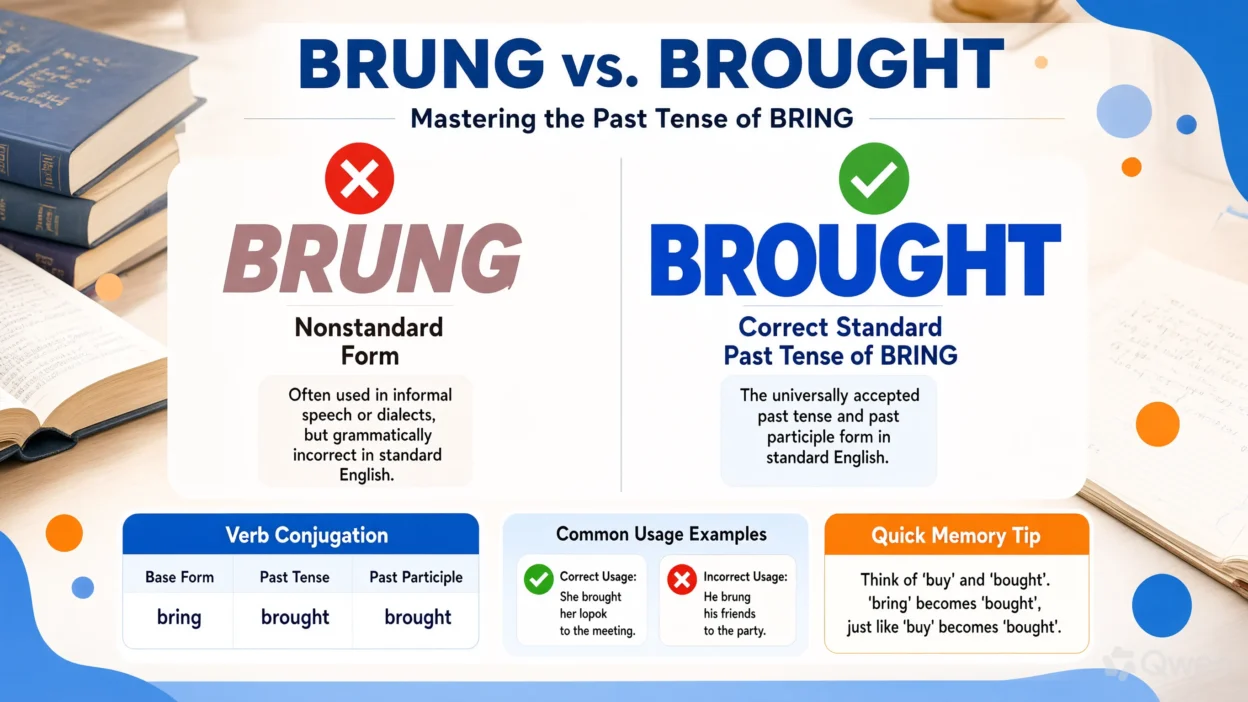
Have you ever wondered if to use brung or brought when talking about something you carried or delivered in the past? These two words sound similar in everyday conversation, which makes them easy to confuse. However, only one is considered the standard past tense of the verb bring in modern English.
The correct word is brought. It is both the simple past tense and the past participle of bring. For example, you should say, “She brought her books to school,” rather than “She brung her books to school.” Although some people use brung in informal speech or regional dialects, it is not accepted as standard English in formal writing, academic work, or professional communication. Understanding the difference will help you speak and write more confidently.
Quick Answer
Brought is the correct standard past tense and past participle of bring. Brung is a nonstandard form sometimes heard in informal speech and regional dialects. Use brought in everyday standard English, school assignments, professional writing, and formal conversations. For example: “I brought my lunch yesterday.”
Why Do People Confuse Brung and Brought?
People confuse brung and brought because both are used when talking about something that was brought from one place to another.
The confusion also comes from how English irregular verbs work. Some verbs change their vowels in the past tense, while others use completely different forms.
For example:
- Sing → Sang → Sung
- Ring → Rang → Rung
- Drink → Drank → Drunk
- Bring → Brought → Brought
Because bring sounds similar to sing and ring, some speakers naturally assume that its past-tense form should be brang or brung.
However, the standard English forms are different. The correct past-tense form is brought, not brung or brang.
What Does Brung Mean?
Brung is a nonstandard past-tense form of bring. It appears in some informal conversations, regional dialects, and varieties of English.
Although people may use it naturally in everyday speech, it is not considered correct in standard written English.
Examples of nonstandard usage:
- He brung his brother to the party.
- She brung some food for everyone.
- They brung their friends along.
Standard English alternatives:
- He brought his brother to the party.
- She brought some food for everyone.
- They brought their friends along.
Is brung a real word?
Brung is a word that exists in some dialects and informal speech. However, it is not the standard past tense of bring. In formal and standard English, use brought instead.
What Does Brought Mean?
Brought is the standard past tense and past participle of the verb bring. It means to carry, take, deliver, or cause someone or something to come to a particular place.
It is used when describing an action that happened in the past or when forming perfect tenses.
Examples:
- I brought my laptop to work.
- She brought flowers for her mother.
- They brought their children to the park.
- He has brought everything we need.
Brought is commonly used in conversations, academic writing, professional communication, and everyday English.
Three Forms of Bring
The verb bring has three main forms:
| Verb Form | Word | Example |
| Base form | Bring | Please bring your notebook. |
| Simple past | Brought | She brought her notebook. |
| Past participle | Brought | She has brought her notebook. |
Remember that brought works as both the simple past tense and the past participle.
Brung vs Brought: What’s the Difference?
The main difference is that brought is the standard English form, while brung is a nonstandard dialectal or informal form.
| Feature | Brung | Brought |
| Standard English | No | Yes |
| Part of speech | Nonstandard verb form | Past tense and past participle |
| Meaning | To bring something in the past | To bring something in the past |
| Formal writing | Avoid | Correct |
| Academic English | Avoid | Correct |
| Informal speech | Used in some dialects | Widely used |
| Example | He brung a gift. | He brought a gift. |
The important point: Both forms may communicate the same general idea, but brought is the appropriate choice in standard English.
When Should You Use Brung or Brought?
Knowing when to use each form helps you avoid grammatical mistakes.
When to Use Brung
Use brung only when you are intentionally reproducing a dialect, informal speech, or a character’s particular way of speaking.
For example:
- The character said, “I brung you something special.”
- In the story, the speaker used the expression “He brung his own tools.”
These examples may be appropriate when representing a particular speaking style in dialogue.
However, avoid using brung in standard essays, professional emails, business documents, and examinations.
When to Use Brought
Use brought whenever you need the standard past tense or past participle of bring.
Examples:
- I brought my homework yesterday.
- My father brought a new phone.
- She has brought some delicious food.
- We brought our friends to the celebration.
- The teacher brought extra books for the students.
If you are unsure which word to choose, brought is almost always the right answer in standard English.
15 Examples of Brung vs Brought in Sentences
Here are 15 examples to help you understand the difference between the two forms.
| Nonstandard Form | Standard English Form |
| He brung his lunch. | He brought his lunch. |
| She brung a gift. | She brought a gift. |
| I brung my notebook. | I brought my notebook. |
| They brung their children. | They brought their children. |
| We brung some snacks. | We brought some snacks. |
| My brother brung his friend. | My brother brought his friend. |
| The teacher brung new books. | The teacher brought new books. |
| She brung her camera. | She brought her camera. |
| He brung the documents. | He brought the documents. |
| I brung some water. | I brought some water. |
| They brung good news. | They brought good news. |
| My mother brung dinner. | My mother brought dinner. |
| We brung our pets. | We brought our pets. |
| John brung his bicycle. | John brought his bicycle. |
| The children brung their toys. | The children brought their toys. |
More Examples Using Brought
Here are some additional examples showing how brought works in different sentence structures.
- Simple past: Sarah brought her favorite book to class.
- Negative sentence: I did not bring my umbrella yesterday.
- Question: Did you bring your keys?
- Present perfect: He has brought his assignment.
- Past perfect: They had brought enough food before the guests arrived.
- Future reference: I will bring my laptop tomorrow.
- Conditional: I would have brought more supplies if I had known.
Notice that the base form bring is used after auxiliary verbs such as did, will, and would have in the appropriate constructions.
Common Mistakes to Avoid
Many English learners make mistakes when using irregular verbs. Here are some common errors involving bring.
1. Using brung instead of brought
- Incorrect: She brung her bag.
- Correct: She brought her bag.
2. Using brang instead of brought
- Incorrect: He brang his lunch.
- Correct: He brought his lunch.
3. Using brought after did
- Incorrect: Did you brought your book?
- Correct: Did you bring your book?
After did, always use the base form of the verb.
4. Using bring instead of brought in the simple past
- Incorrect: I bring my laptop yesterday.
- Correct: I brought my laptop yesterday.
5. Using brung in formal writing
- Incorrect: The manager brung the documents.
- Correct: The manager brought the documents.
Avoiding these mistakes will make your English clearer and more grammatically accurate.
Easy Memory Trick: How to Remember Brought
A simple way to remember the correct form is to memorize the three forms together:
Bring → Brought → Brought
Think of the word bought. The word brought has a similar ending and spelling pattern.
You can also remember this simple rule:
- Today: I bring my bag.
- Yesterday: I brought my bag.
- I have: I have brought my bag.
Whenever you feel tempted to write brung or brang, remember that standard English uses brought.
Brung vs Brought in American and British English
There is no difference between American and British standard English when it comes to the past tense of bring.
Both varieties use brought as the simple past tense and past participle.
| English Variety | Standard Past Tense | Example |
| American English | Brought | She brought her lunch. |
| British English | Brought | She brought her lunch. |
| Australian English | Brought | She brought her lunch. |
| Canadian English | Brought | She brought her lunch. |
Although brung may appear in informal speech or regional dialects, it is not the standard past-tense form in these varieties.
Therefore, whether you are learning American English or British English, remember to use brought.
Similar Words to Brung and Brought
Learning other irregular verbs can help you understand why bring follows a different pattern.
Here are some common irregular verbs and their correct forms:
| Base Form | Past Tense | Past Participle |
| Bring | Brought | Brought |
| Buy | Bought | Bought |
| Think | Thought | Thought |
| Catch | Caught | Caught |
| Teach | Taught | Taught |
| Sing | Sang | Sung |
| Ring | Rang | Rung |
| Drink | Drank | Drunk |
| Begin | Began | Begun |
| Run | Ran | Run |
Notice that sing, ring, and drink follow different patterns from bring.
This is why you should learn irregular verbs individually instead of assuming they all follow the same spelling pattern.
Final Verdict: Brung or Brought?
The correct choice in standard English is brought.
- Brung: A nonstandard form sometimes used in informal speech and regional dialects.
- Brought: The standard past tense and past participle of bring.
For school assignments, examinations, professional writing, and everyday standard English, always choose brought.
Correct: She brought her friends to the party.
Nonstandard: She brung her friends to the party.
If you want to improve your English grammar, remembering the three forms of bring will help you avoid this common mistake.
FAQs:
1. Is brung a real word?
Yes, brung exists as a nonstandard form used in some regional dialects and informal speech. However, it is not the standard past tense of bring. In standard English, the correct form is brought.
2. Is brung or brought grammatically correct?
Brought is grammatically correct in standard English. Brung is a nonstandard dialectal form. Use brought in formal writing, schoolwork, professional communication, and standard conversations.
3. What is the past tense of bring?
The past tense of bring is brought. For example: “I brought my books to school yesterday.” The word brung is not the standard past-tense form.
4. Is brung ever acceptable?
Brung can be acceptable when intentionally representing a regional dialect, informal speech, or a character’s voice in creative writing. However, it should not be used as the standard past tense in formal English.
5. Is brang the correct past tense of bring?
No. Brang is also a nonstandard form. The correct standard past tense of bring is brought. For example, say “He brought his lunch,” not “He brang his lunch.”
6. What is the past participle of bring?
The past participle of bring is brought. It is used with helping verbs such as has, have, and had.
Examples:
- She has brought her books.
- I have brought my laptop.
- They had brought enough food.
7. Why do people say brung instead of brought?
Some speakers use brung because it resembles the past-tense forms of other irregular verbs, such as sang and rang. It is also established in certain dialects and informal speech. However, brought remains the standard form.
Remember This
Brought is correct!
Bring → Brought → Brought
- Brung = Nonstandard dialectal form
- Brought = Standard past tense
- Brought = Standard past participle
Example: I brought my lunch to school yesterday.
Conclusion
Understanding the difference between brung and brought is simple once you learn the correct forms of the verb bring. Although brung is sometimes heard in informal conversations and regional dialects, it is not accepted as the standard past tense. The correct form is brought, which also serves as the past participle.
Whenever you write about something you carried, delivered, or took somewhere in the past, use brought. Remember the pattern bring, brought, brought, and you will be able to use this irregular verb confidently in everyday conversations, academic writing, and professional communication.

Lucas Smith is a skilled language writer at Synomity.com, passionate about synonyms, vocabulary enrichment, and word meanings. He develops engaging content that helps readers strengthen communication skills and expand their understanding of language.