
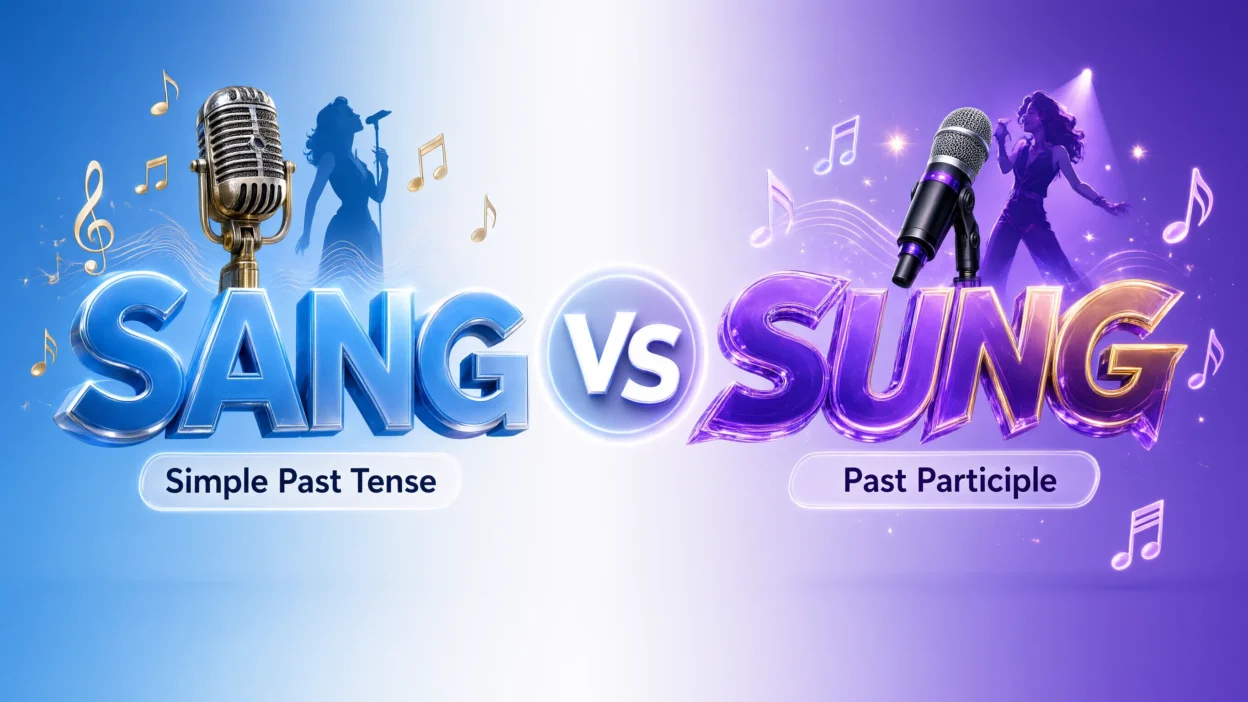
If you are confused about sang or sung, you are not alone. Both words come from the verb sing, but they are used in different grammatical situations. The correct choice depends on how a sentence is structured and whether you are talking about a completed action or using a helping verb.
The simple answer is that sang is the simple past tense of sing, while sung is the past participle. For example, you should say, “She sang a beautiful song yesterday.” However, when using a helping verb such as has, have, or had, you should say, “She has sung a beautiful song.”
Understanding this difference will help you avoid common grammar mistakes and make your English sound more natural. In this guide, you will learn the meanings, grammatical rules, examples, and differences between these two forms.
Quick Answer: Sang or Sung?
Sang is the simple past tense of sing, while sung is its past participle. Use sang for a completed action in the past without a helping verb. Use sung with helping verbs such as has, have, and had. For example: “He sang yesterday” and “He has sung before.”
Why Do People Confuse Sang and Sung?
People often confuse these words because both are forms of the same irregular verb, sing. They describe the same basic action but follow different grammatical rules.
Unlike regular verbs that form their past tense by adding -ed, the verb sing changes its spelling:
- Sing – Base form
- Sang – Simple past tense
- Sung – Past participle
The confusion usually happens because learners assume that sang and sung can be used interchangeably.
However, English grammar gives each word a specific role. Remembering their grammatical functions makes choosing the correct form much easier.
What Does Sang Mean?
Sang is the simple past tense of the verb sing. It describes an action of producing musical sounds with your voice that happened and finished in the past.
Use sang when talking about a past singing activity without a perfect-tense helping verb.
Examples:
- She sang beautifully at the wedding.
- I sang my favorite song yesterday.
- They sang together during the concert.
- He sang in the school competition.
In each example, the action happened in the past.
When Should You Use Sang?
Use sang when:
- Describing a completed singing action in the past.
- Talking about something someone did yesterday or last week.
- Telling a story about a past performance.
- Describing a past event without using a perfect-tense auxiliary verb.
Example: My brother sang at the school concert last night.
What Does Sung Mean?
Sung is the past participle of the verb sing. It is generally used with helping verbs such as has, have, and had to form perfect tenses.
It can also be used in passive constructions with forms of be.
Examples:
- She has sung this song before.
- I have sung in many competitions.
- They had sung together before the show.
- The national anthem was sung by the students.
In these sentences, sung works with another verb to complete the grammatical structure.
When Should You Use Sung?
Use sung when:
- Forming the present perfect tense.
- Forming the past perfect tense.
- Forming the future perfect tense.
- Creating passive-voice sentences.
Example: He has sung this song many times.
Here, has is the helping verb, and sung is the past participle.
Sang vs Sung: What Is the Difference?
The main difference between sang and sung is their grammatical function. Both describe the action of singing, but they cannot normally replace each other.
| Feature | Sang | Sung |
| Verb form | Simple past | Past participle |
| Base verb | Sing | Sing |
| Usage | Past actions | Perfect tenses and passive voice |
| Helping verb | Not normally needed | Usually needs a helping verb |
| Example | She sang yesterday. | She has sung before. |
| Correct structure | Subject + sang | Subject + has/have/had + sung |
Easy rule: Use sang for simple past sentences and sung with perfect-tense helping verbs.
When to Use Sang and Sung
Choosing between these words becomes easier when you understand the sentence structure.
Use Sang for Simple Past Actions
When an action happened in the past and you are simply reporting it, use sang.
Examples:
- She sang at my birthday party.
- We sang our favorite song.
- The children sang loudly.
Use Sung With Has, Have, or Had
When using perfect tenses, use sung instead of sang.
Examples:
- She has sung professionally.
- We have sung this song before.
- They had sung before the audience arrived.
Use Sung in Passive Voice
You can also use sung when the subject receives the action.
Examples:
- The song was sung beautifully.
- The national anthem was sung by the choir.
- This melody has been sung for generations.
15 Examples of Sang and Sung in Sentences
The following examples will help you understand how both words work in everyday English.
Examples of Sang
- She sang a beautiful song at the wedding.
- I sang with my friends last night.
- The children sang during the school assembly.
- He sang his favorite song in the car.
- We sang together around the campfire.
- My mother sang a lullaby to the baby.
- The singer sang beautifully on stage.
- They sang the national anthem before the match.
Examples of Sung
- She has sung in several music competitions.
- I have sung this song many times.
- He had sung before the audience arrived.
- They have sung together since childhood.
- The song was sung by a famous artist.
- The children had sung three songs before lunchtime.
- This beautiful melody has been sung for many years.
These examples show that sang works independently as a simple past verb, while sung usually needs a helping verb.
Common Mistakes When Using Sang and Sung
Even experienced English learners sometimes make mistakes with irregular verbs. Here are some common errors and their corrections.
| Incorrect Sentence | Correct Sentence |
| She sung yesterday. | She sang yesterday. |
| He has sang a song. | He has sung a song. |
| I have sang before. | I have sung before. |
| They had sang together. | They had sung together. |
| She sung beautifully last night. | She sang beautifully last night. |
| The song was sang by him. | The song was sung by him. |
Remember these rules:
- Do not use sung alone as the simple past tense.
- Do not use sang after has, have, or had.
- Use sung in passive constructions such as “was sung.”
- Learn all three forms of the irregular verb together.
Easy Memory Trick to Remember Sang vs Sung
Here is a simple trick to remember the difference:
Sang = Simple Past
Think of a sentence about yesterday:
– She sang yesterday.
Sung = With a Helping Verb
Think of a sentence with has, have, or had:
– She has sung before.
Remember this three-word pattern:
Sing → Sang → Sung
- Sing = Present
- Sang = Past
- Sung = Past participle
If you remember this sequence, you will find it much easier to choose the correct word.
American vs British English: Is There Any Difference?
There is no spelling difference between sang and sung in American and British English. Both varieties use the same standard verb forms.
| English Variety | Simple Past | Past Participle |
| American English | Sang | Sung |
| British English | Sang | Sung |
| Australian English | Sang | Sung |
| Canadian English | Sang | Sung |
For example:
- American English: She sang at the concert.
- British English: She has sung at the concert.
Both varieties follow the same grammatical rules. The difference is not regional; it is grammatical.
Similar Words: Other Forms of Irregular Verbs
English contains many irregular verbs that change their spelling instead of simply adding -ed.
Here are some examples similar to sing, sang, and sung.
| Base Form | Simple Past | Past Participle |
| Ring | Rang | Rung |
| Drink | Drank | Drunk |
| Swim | Swam | Swum |
| Begin | Began | Begun |
| Sink | Sank | Sunk |
| Spring | Sprang | Sprung |
| Shrink | Shrank | Shrunk |
| Run | Ran | Run |
| Give | Gave | Given |
| Write | Wrote | Written |
Learning these verb patterns together can improve your understanding of English grammar and help you recognize irregular verbs more easily.
Final Verdict: Sang or Sung?
The correct choice depends on the grammatical structure of your sentence.
- Sang is the correct simple past tense of sing.
- Sung is the correct past participle of sing.
Use sang when describing a completed action in the past: “She sang a beautiful song.”
Use sung with helping verbs: “She has sung a beautiful song.”
Both words are correct, but they are not interchangeable. Understanding their grammatical roles will help you write and speak English more accurately.
FAQs:
1. Is it sang or sung?
Both are correct forms of the verb sing. However, sang is the simple past tense, while sung is the past participle. For example, “He sang yesterday” and “He has sung before.”
2. Is sang the past tense of sing?
Yes. Sang is the simple past tense of sing. Use it when describing an action that happened in the past. For example: “She sang at the party last night.”
3. Is sung a past tense or past participle?
Sung is the past participle of sing. It is used with helping verbs such as has, have, and had. For example: “They have sung together before.”
4. Is it I sang or I sung?
The correct standard form is “I sang” when using the simple past tense. However, “I have sung” is correct when using the present perfect tense.
5. Is it has sang or has sung?
“Has sung” is correct. The helping verb has must be followed by the past participle sung. For example: “She has sung this song many times.”
6. Is it sung or sang yesterday?
Sang is correct because yesterday refers to a completed action in the past. For example: “He sang at the school event yesterday.”
7. What are the three forms of sing?
The three forms of sing are:
- Present: Sing
- Past: Sang
- Past participle: Sung
For example: “I sing every day,” “I sang yesterday,” and “I have sung before.
8. Can I use sung without a helping verb?
In standard English, sung generally needs a helping verb when used as a verb, such as in “has sung” or “was sung.” However, it can also appear without one when functioning as an adjective or in a reduced participial phrase.
Remember This
SANG
Simple Past Tense
She sang a song yesterday.
SUNG
Past Participle
She has sung a song before.
Sing → Sang → Sung
Learn this sequence to remember the correct forms.
Conclusion
Understanding the difference between sang and sung is simple once you learn their grammatical roles. Sang is the simple past tense of sing, while sung is the past participle. Although both words describe the same singing action, they are used in different sentence structures.
Remember to use sang for completed past actions and sung with helping verbs such as has, have, and had. Practice these forms with everyday sentences, and you will soon use them naturally and confidently. The easiest way to remember is: Sing, Sang, Sung.

Lucas Smith is a skilled language writer at Synomity.com, passionate about synonyms, vocabulary enrichment, and word meanings. He develops engaging content that helps readers strengthen communication skills and expand their understanding of language.