
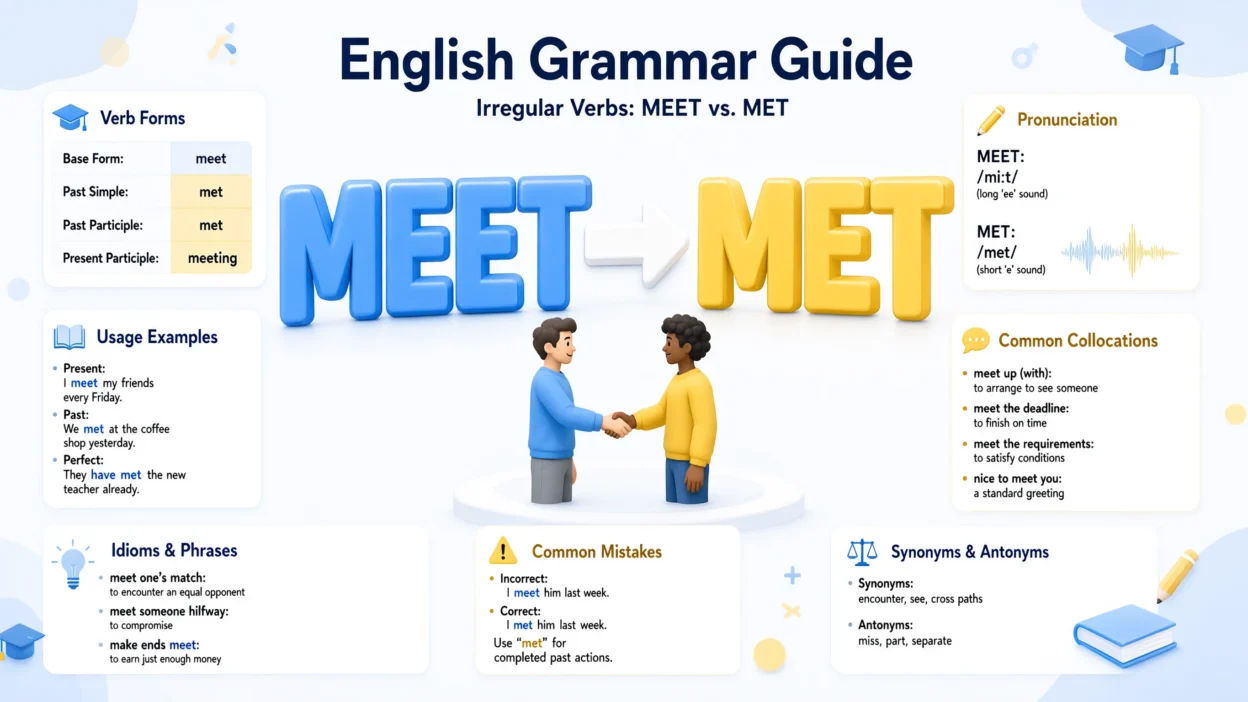
The past tense of meet is met. The verb meet is an irregular verb, so it does not form its past tense by adding -ed. Instead, its spelling changes from meet to met. For example, “I meet my friends every weekend” becomes “I met my friends last weekend.” Understanding this change is important for speaking and writing correct English.
Many English learners confuse meet, met, and met because these forms are used in different grammatical situations. Although they look similar, each has a specific purpose. The present form describes something happening now or regularly, while the past form describes an action that has already happened.
The past participle is also met, and it is used with helping verbs such as have, has, and had. In this guide, you will learn the three forms of meet, their meanings, grammar rules, common mistakes, and practical examples.
Quick Answer: What Is the Past Tense of Meet?
The past tense of meet is met. It is an irregular verb, meaning it does not follow the regular -ed pattern. The three main forms are meet – met – met. Use met for completed past actions and as the past participle with helping verbs such as have, has, and had.
Why Do People Confuse Meet and Met?
People often confuse meet and met because English uses different verb forms to show when an action happens.
The main reason is that meet is an irregular verb. Unlike regular verbs such as walk (walked) or play (played), it changes its spelling when used in the past.
Another common reason is that both the simple past and past participle forms are spelled met. However, their grammatical uses are different.
For example:
- Present: I meet new people at work.
- Past: I met a new colleague yesterday.
- Past participle: I have met many interesting people.
Understanding these differences makes it easier to use the verb correctly.
First Word: Meet
Meet is the base form and present-tense form of the verb. It means to come together with someone, see someone, or become acquainted with a person for the first time.
It can also mean gathering with others for a discussion, appointment, or planned activity.
Examples of Meet in Sentences:
- I meet my friends every Friday.
- We meet our teacher after class.
- They meet at the coffee shop.
- I want to meet your family.
- We usually meet in the morning.
When to Use Meet
Use meet when:
- Talking about regular or repeated activities.
- Describing something happening in the present.
- Using the base form after words such as to, will, or can.
- Talking about plans or future meetings.
Examples:
- I will meet you tomorrow.
- She wants to meet the manager.
- Can we meet after lunch?
Second Word: Met
Met is the simple past tense and past participle of meet. It describes an action that happened in the past or is used with helping verbs to form perfect tenses.
Unlike regular verbs, meet does not become meeted. Its correct past form is always met.
Examples of Met in Sentences:
- I met my best friend yesterday.
- She met her new neighbors last week.
- We met at the school entrance.
- They met the manager on Monday.
- He met his future wife in college.
When to Use Met
Use met when:
- Describing a completed past action.
- Talking about a previous meeting or introduction.
- Forming present perfect or past perfect tenses with helping verbs.
- Explaining when you first became acquainted with someone.
Examples:
- I met him two years ago.
- She has met my parents.
- We had met before the event.
Meet vs. Met: Comparison Table
Here is a simple comparison of the different forms of the verb meet.
| Verb Form | Word | Example |
| Base form | Meet | I meet my friends. |
| Simple past | Met | I met my friends yesterday. |
| Past participle | Met | I have met my friends. |
| Present participle | Meeting | I am meeting my friends. |
| Third-person singular | Meets | She meets her clients. |
Important: The simple past and past participle forms are both met, but they are used differently in sentences.
When to Use Meet and Met
Choosing between meet and met depends on the time of the action and the grammatical structure of your sentence.
1. Use Meet for Present Actions
Use meet when talking about something that happens regularly or is generally true.
Examples:
- I meet my classmates every morning.
- We meet twice a week.
- They meet at the library.
2. Use Met for Completed Past Actions
Use met when an action happened and finished in the past.
Examples:
- I met him yesterday.
- She met her new teacher last month.
- We met during our vacation.
3. Use Met With Have, Has, and Had
Use met as the past participle after helping verbs to form perfect tenses.
Examples:
- I have met your brother.
- She has met the new director.
- They had met before the conference.
4. Use Meet After Will, Can, and To
The base form meet is used after modal verbs and the infinitive marker to.
Examples:
- I will meet you tomorrow.
- We can meet after work.
- She wants to meet the team.
12 Examples of Meet and Met in Sentences
The following examples show how to use both forms correctly in everyday English.
| No. | Sentence | Verb Form |
| 1 | I meet my friends every Sunday. | Present |
| 2 | We met at the restaurant yesterday. | Past |
| 3 | She meets her clients regularly. | Present |
| 4 | He met his teacher last week. | Past |
| 5 | They have met before. | Past participle |
| 6 | I will meet you at the station. | Base form |
| 7 | We met during the school event. | Past |
| 8 | She wants to meet the new students. | Base form |
| 9 | I have never met him before. | Past participle |
| 10 | My parents meet their friends often. | Present |
| 11 | They had met before moving abroad. | Past participle |
| 12 | He met an old friend at the airport. | Past |
More Everyday Examples
- Nice to meet you.
- It was great to meet your family.
- I met someone interesting today.
- We are meeting our friends tonight.
- Have you met the new teacher?
These examples demonstrate how the verb changes according to the sentence structure.
Common Mistakes When Using Meet and Met
English learners sometimes use the wrong form of this irregular verb. Here are common mistakes and their corrections.
| Incorrect Sentence | Correct Sentence |
| I meeted him yesterday. | I met him yesterday. |
| She has meet my brother. | She has met my brother. |
| We meet him last night. | We met him last night. |
| They had meet before. | They had met before. |
| He will met you tomorrow. | He will meet you tomorrow. |
| I have meet her before. | I have met her before. |
Remember these grammar rules:
- Never write meeted as the past tense of meet.
- Use met for completed past actions.
- Use met after have, has, and had.
- Use meet after will, can, and to.
- Use meeting with forms of the verb be when forming continuous tenses.
Memory Trick: How to Remember the Past Tense of Meet
A simple way to remember the past tense is to connect the word meet with met.
Think of this easy pattern:
Meet → Met → Met
- Meet = Present
- Met = Past
- Met = Past participle
Remember this sentence:
“I meet people today, I met people yesterday, and I have met many people before.”
Practice saying this sentence aloud several times. It will help you remember the correct forms naturally.
American vs. British English: Is the Past Tense Different?
No. The past tense of meet is the same in both American and British English.
Both varieties use:
- Present: Meet
- Past: Met
- Past participle: Met
- I met my neighbor yesterday.
- We have met before.
Examples in British English:
- I met my neighbour yesterday.
- We have met before.
The main spelling difference in these examples is neighbor (American English) and neighbour (British English). The verb meet does not change between the two varieties.
Similar Words to Meet and Met
Learning other irregular verbs can help you understand how English verbs change in the past tense.
Here are some useful examples:
| Present | Past | Past Participle |
| Meet | Met | Met |
| Keep | Kept | Kept |
| Sleep | Slept | Slept |
| Feel | Felt | Felt |
| Leave | Left | Left |
| Lose | Lost | Lost |
| Read | Read | Read |
| Find | Found | Found |
| Get | Got | Got/Gotten |
| Send | Sent | Sent |
These verbs do not follow the regular -ed pattern, so learning their forms is important for correct English communication.
Final Verdict: Is It Meet or Met?
The correct past tense of meet is met, not meeted. The verb meet is irregular, and its three main forms are meet – met – met.
Use meet for present actions and the base form, and use met for completed past actions. Use met after have, has, and had when forming perfect tenses.
FAQs:
1. What is the past tense of meet?
The past tense of meet is met. It is an irregular verb, so you cannot form its past tense by simply adding -ed. For example: “I met my friend yesterday.”
2. Is Meeted a Correct Word?
No. Meeted is not the standard past tense of meet. The correct form is met. For example, write “She met her teacher yesterday,” not “She meeted her teacher yesterday.”
3. What Is the Past Participle of Meet?
The past participle of meet is also met. It is used with helping verbs such as have, has, and had. For example: “I have met your brother before.”
4. Is Meet an Irregular Verb?
Yes. Meet is an irregular verb because it does not follow the normal pattern of adding -ed to form the past tense. Its forms are meet, met, and met.
5. What Are the Three Forms of Meet?
The three main forms of meet are:
- Base form: Meet
- Past tense: Met
- Past participle: Met
Example: “I meet new people, I met someone yesterday, and I have met many interesting people.”
6. Should I Use Meet or Met in a Sentence?
Use meet for present actions, general activities, and after modal verbs such as will and can. Use met for completed past actions and after have, has, or had.
Example: “I meet him regularly” and “I met him yesterday.”
7. What Is the Present Participle of Meet?
The present participle of meet is meeting. It is used in continuous tenses.
Example: “I am meeting my friends this evening.”
Remember This
Meet – Met – Met
- Meet: Present tense
- Met: Simple past tense
- Met: Past participle
- Meeting: Present participle
Never use “meeted” as the standard past tense.
Conclusion
The past tense of meet is met. It is an irregular verb with three main forms: meet, met, and met. Understanding these forms will help you avoid common grammar mistakes and communicate more confidently in English.
Remember to use meet for present actions and after modal verbs, while met is used for completed past actions and with helping verbs in perfect tenses. Practice these forms with everyday sentences to improve your English grammar and writing skills.

John Morrison is a dedicated content writer at Synomity.com, focused on synonyms, vocabulary development, and word meanings. He creates clear, educational resources that help readers improve language skills and communicate with confidence.