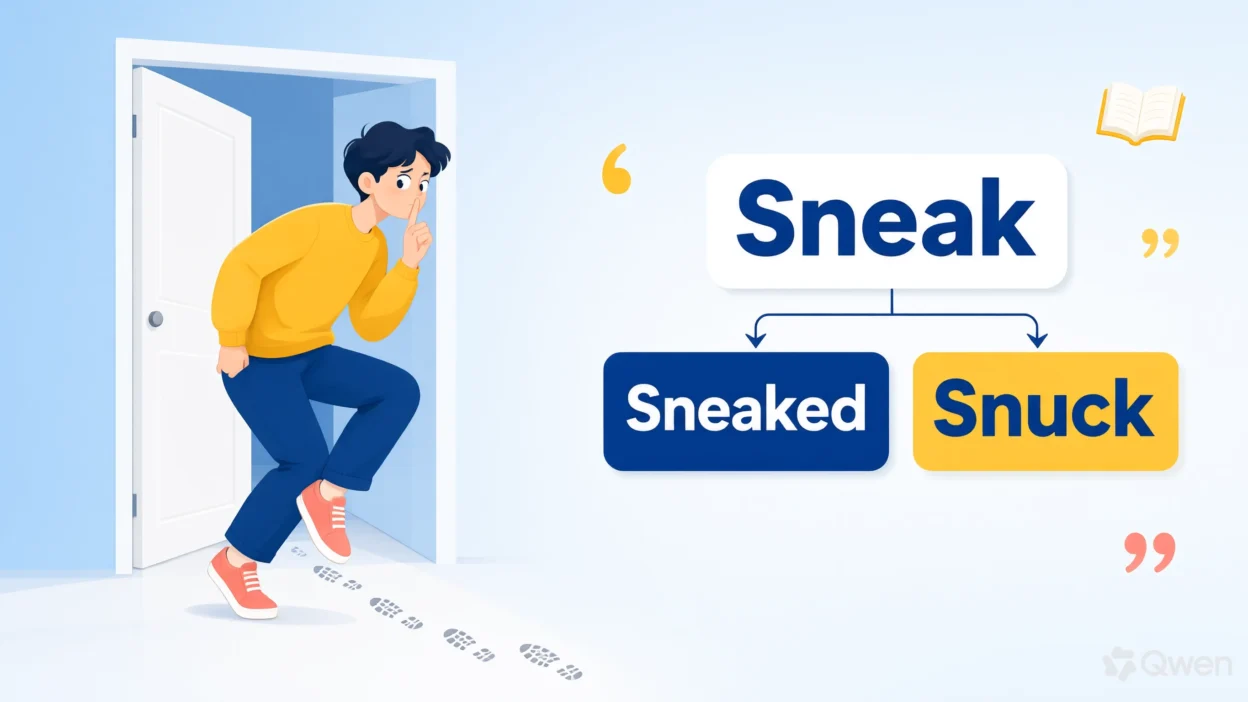
The past tense of sneak is sneaked or snuck. Both forms are correct and widely used in modern English. Sneaked is the regular past-tense form, while snuck is an irregular form that is especially common in American English. For example, you can say, “He sneaked into the room” or “He snuck into the room.” Both sentences are grammatically correct.
The verb sneak means to move quietly, secretly, or carefully to avoid being noticed. People often become confused about its past tense because English has two acceptable forms. Some verbs follow regular patterns by adding -ed, while others develop irregular past-tense forms.
Understanding when to use sneaked and snuck will help you speak and write more naturally. In this guide, you will learn the different forms of sneak, their meanings, grammatical uses, pronunciation, and practical examples.
Quick Answer: What Is the Past Tense of Sneak?
The past tense of sneak is sneaked or snuck. Both are correct. Sneaked is the regular past-tense form, while snuck is an irregular alternative commonly used in American English. The past participle can also be either sneaked or snuck, depending on the sentence.
Why Do People Confuse Sneaked and Snuck?
People confuse these words because they express the same action but follow different grammatical patterns.
English normally forms the past tense of regular verbs by adding -ed. For example:
- Walk → Walked
- Talk → Talked
- Jump → Jumped
- Sneak → Sneaked
However, English also contains irregular verbs that change their spelling in the past tense. The form snuck developed as an alternative to sneaked.
Both forms are accepted in modern English, so choosing between them is usually a matter of writing style, regional preference, and personal preference.
First Word: Sneaked
Sneaked is the regular past-tense and past-participle form of the verb sneak. It describes an action that happened secretly, quietly, or without attracting attention.
It is formed by adding -ed to the base verb.
Meaning of Sneaked
Sneaked means moved secretly or quietly to avoid being seen, heard, or noticed.
Examples:
- The children sneaked into the kitchen at midnight.
- She sneaked out of the house without waking anyone.
- He sneaked a piece of chocolate from the box.
- They sneaked past the security guard.
- The cat sneaked into the bedroom.
When Should You Use Sneaked?
Use sneaked when you want the traditional regular past-tense form.
It is especially suitable for:
- Formal and academic writing.
- Professional communication.
- British English.
- Situations where you prefer a regular verb form.
- Writing that requires consistent regular past-tense patterns.
Example: She sneaked into the library to find a quiet place to study.
Second Word: Snuck
Snuck is an irregular past-tense and past-participle form of sneak. It has the same basic meaning as sneaked but does not follow the regular -ed pattern.
It is particularly common in American English and everyday conversation.
Meaning of Snuck
Snuck means moved quietly, secretly, or carefully to avoid being noticed.
Examples:
- He snuck out after everyone went to sleep.
- The dog snuck into the kitchen.
- She snuck a cookie before dinner.
- They snuck behind the building.
- My brother snuck into my room.
When Should You Use Snuck?
Use snuck when you want a natural, conversational style, especially in American English.
It is suitable for:
- Everyday conversations.
- Informal writing.
- Stories and fictional dialogue.
- American English.
- Casual descriptions of secret actions.
Example: He snuck into the house without making any noise.
Sneaked vs Snuck: Comparison Table
Both words are correct, but they differ in their grammatical formation and typical usage.
| Feature | Sneaked | Snuck |
| Base verb | Sneak | Sneak |
| Past tense | Sneaked | Snuck |
| Past participle | Sneaked | Snuck |
| Verb type | Regular form | Irregular form |
| Meaning | Moved secretly | Moved secretly |
| American English | Common | Very common |
| British English | Common | Also used |
| Formal writing | Suitable | Depends on style |
| Informal speech | Common | Very common |
Important: Neither form changes the basic meaning of the verb. The choice is mainly about grammatical style and regional preference.
When to Use Each: Sneaked or Snuck?
Choosing the correct form depends on your audience, writing style, and preference.
1. Use Sneaked in Formal Writing
If you are writing an academic assignment, report, or formal document, sneaked is a safe choice.
Example: The suspect sneaked through the back entrance.
2. Use Snuck in Casual Conversations
In everyday American English, snuck sounds natural and familiar.
Example: I snuck downstairs to get some water.
3. Use Either Form in General Writing
Both forms are grammatically acceptable. You can choose either one as long as you use it consistently.
Example:
- She sneaked into the classroom.
- She snuck into the classroom.
Both sentences are correct.
15 Examples of Sneak in Sentences
Here are 15 practical examples showing how to use sneak, sneaked, and snuck correctly.
| No. | Sentence |
| 1 | He sneaked out of the house quietly. |
| 2 | She snuck into the kitchen. |
| 3 | The boy sneaked behind the door. |
| 4 | They snuck into the movie theater. |
| 5 | I sneaked a quick look at the answer. |
| 6 | My cat snuck under the bed. |
| 7 | We sneaked past the sleeping dog. |
| 8 | He snuck a snack into his bedroom. |
| 9 | The children sneaked into the garden. |
| 10 | She snuck out before the meeting ended. |
| 11 | Someone sneaked into the office last night. |
| 12 | The thief snuck through an open window. |
| 13 | I sneaked into the room to surprise her. |
| 14 | They snuck away before anyone noticed. |
| 15 | The puppy sneaked onto the sofa. |
These examples show that both forms can describe secret movements, quiet actions, or doing something without being noticed.
Common Mistakes When Using Sneak
Even though sneaked and snuck are both correct, learners sometimes make mistakes when using them.
Mistake 1: Using Sneaked and Snuck as Different Meanings
Incorrect understanding: Sneaked means walking quietly, while snuck means stealing.
Correct explanation: Both forms have the same basic meaning. Neither word automatically means stealing.
Mistake 2: Writing Sneakeded
Incorrect: He sneakeded into the room.
Correct: He sneaked into the room.
The word sneaked already contains the past-tense ending.
Mistake 3: Writing Snucked
Incorrect: She snucked outside.
Correct: She snuck outside.
The accepted irregular form is snuck, not snucked.
Mistake 4: Using Sneak Instead of Its Past Form
Incorrect: Yesterday, he sneak into the house.
Correct: Yesterday, he sneaked into the house.
You need a past-tense form when describing an action that happened yesterday.
Mistake 5: Using Sneaked and Snuck Inconsistently
Avoid switching between forms unnecessarily in the same piece of writing. Although both are correct, choosing one form can make your writing more consistent.
Easy Memory Trick: How to Remember Sneaked and Snuck
Remember this simple rule:
- Sneaked = Regular past tense: Sneak + ed.
- Snuck = Irregular past tense: A shorter alternative.
Think of these examples:
- Today: I sneak into the room.
- Yesterday: I sneaked into the room.
- Yesterday: I snuck into the room.
Both past-tense sentences are correct.
Quick tip: If you are unsure which form to choose in formal writing, use sneaked. If you are having a casual conversation in American English, snuck is a natural choice.
Sneaked vs Snuck in American and British English
Both American and British English recognize sneaked and snuck, but their usage preferences can differ.
American English
In American English, snuck is extremely common in everyday speech and informal writing. However, sneaked is also widely understood and accepted.
Examples:
- He snuck out of the house.
- She sneaked into the office.
British English
In British English, sneaked has traditionally been the more established form. However, snuck is also used and understood.
Examples:
- The children sneaked into the garden.
- He snuck into the room.
Remember: The difference is a preference, not a strict grammatical rule. Both forms are correct in modern English.
Similar Words to Sneak
Learning related words can help you improve your vocabulary and describe secret movements more accurately.
| Word | Meaning | Example |
| Creep | Move slowly and quietly | He crept toward the door. |
| Tiptoe | Walk quietly on your toes | She tiptoed across the room. |
| Slip | Move quietly or unnoticed | He slipped out of the meeting. |
| Steal | Take something secretly | Someone stole my wallet. |
| Prowl | Move around quietly while searching | The cat prowled around the garden. |
| Skulk | Move secretly to avoid attention | He skulked around the building. |
| Stalk | Follow someone quietly | The hunter stalked the animal. |
| Slip away | Leave without being noticed | She slipped away early. |
These words are related to secret or quiet movement, but they are not always interchangeable. Each has its own meaning and context.
Final Verdict: Sneaked or Snuck?
The correct past tense of sneak is both sneaked and snuck.
- Sneaked: The regular past-tense form.
- Snuck: The irregular past-tense alternative.
Both words describe moving secretly or quietly to avoid being noticed. Sneaked is a traditional choice, while snuck is especially popular in American English conversations.
You can confidently use either form in modern English. Choose the one that best matches your writing style and audience.
FAQs:
1. What is the past tense of sneak?
The past tense of sneak is sneaked or snuck. Both forms are correct. Sneaked is regular, while snuck is irregular and especially common in American English.
2. Is sneaked or snuck grammatically correct?
Both sneaked and snuck are grammatically correct. They have the same basic meaning and can be used to describe moving secretly or quietly.
3. Is snuck a real word?
Yes, snuck is a real and accepted English word. It is an irregular past-tense form of sneak and is widely used in modern English.
4. What is the past participle of sneak?
The past participle of sneak can be either sneaked or snuck.
Examples:
- She has sneaked into the room.
- She has snuck into the room.
Both sentences are correct.
5. Is snuck more common in American or British English?
Snuck is especially common in American English. British English has traditionally favored sneaked, although both forms are understood and used in Britain.
6. Is sneaked more formal than snuck?
Generally, sneaked is a safer choice for formal writing because it follows the regular past-tense pattern. However, snuck is also accepted English and is not grammatically incorrect.
7. What are the three forms of sneak?
The three principal forms of sneak are:
- Base form: Sneak
- Past tense: Sneaked or Snuck
- Past participle: Sneaked or Snuck
Example: I sneak into the room. Yesterday, I sneaked into the room. I have snuck into the room before.
Remember This
Sneak – Sneaked – Sneaked
Regular verb form
Sneak – Snuck – Snuck
Irregular alternative
Both are correct
Sneaked and snuck have the same basic meaning. Choose either form according to your preferred writing style.
Conclusion
Understanding the past tense of sneak is simple once you know that both sneaked and snuck are correct. The word sneaked follows the regular English past-tense pattern, while snuck is an irregular alternative. Both describe moving secretly, quietly, or without attracting attention.
For formal writing, sneaked is a reliable choice. For everyday conversations, especially in American English, snuck sounds natural. Remember these two forms, practice them with example sentences, and you will be able to use them confidently in your speaking and writing.

Lucas Smith is a skilled language writer at Synomity.com, passionate about synonyms, vocabulary enrichment, and word meanings. He develops engaging content that helps readers strengthen communication skills and expand their understanding of language.