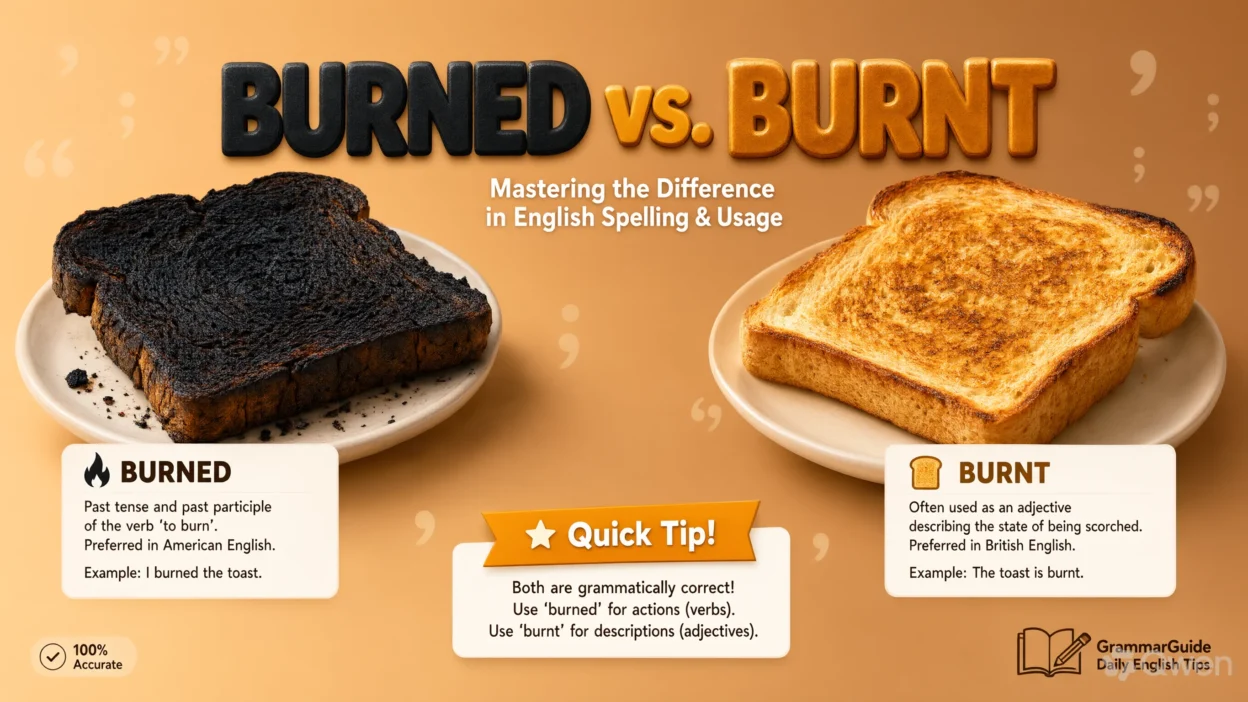
The words burned and burnt are both correct past-tense forms and past participles of the verb burn. They describe something that was damaged by fire or heat, or the process of producing heat and flames. However, their usage can depend on the type of English being spoken and the context of a sentence. If you are wondering if to write burned or burnt, the good news is that you can use either form in many situations.
The main difference is that burned is more common in American English, while burnt is especially common in British English. Both forms are also widely understood internationally. In addition, burnt often appears as an adjective in expressions such as burnt toast and burnt sugar.
Understanding these small differences will help you choose the right word when writing essays, emails, stories, and everyday conversations.
Quick Answer: Burned or Burnt?
Both burned and burnt are correct. They are the past tense and past participle forms of the verb burn. American English generally prefers burned, while British English commonly uses burnt. Both forms can describe something damaged by fire or heat. For example, you can say “I burned my toast” or “I burnt my toast.”
Why Do People Confuse Burned and Burnt?
People often confuse these words because they have the same basic meaning and grammatical function.
The confusion comes from three main reasons:
- Similar meanings: Both words describe the result or action of burning something.
- Different regional preferences: American and British English often favor different forms.
- Different writing styles: Some writers prefer burned for verbs and burnt for adjectives, although this distinction is not a strict grammatical rule.
For example:
- I burned the paper yesterday.
- I burnt the paper yesterday.
Both sentences are grammatically correct and communicate the same idea.
What Does Burned Mean?
Burned is the regular past-tense and past-participle form of the verb burn. It means that something caught fire, was damaged by heat, or was exposed to flames.
It is particularly common in American English and is suitable for formal writing, academic work, and everyday communication.
Examples of Burned in Sentences
- She burned the old letters in the fireplace.
- I burned my hand while cooking dinner.
- The candle burned throughout the night.
- He burned the vegetables by leaving them on the stove.
- The sun burned my skin during the afternoon.
- They burned the wooden furniture.
- The house burned down last winter.
- I have burned my favorite shirt.
- The fire burned for several hours.
- She burned the midnight oil to finish her project.
Simple meaning: Burned means something was affected by fire or heat, or that someone caused something to burn.
What Does Burnt Mean?
Burnt is an alternative past-tense and past-participle form of the verb burn.
Examples of Burnt in Sentences
- I burnt the toast this morning.
- She burnt her finger on the hot pan.
- The wood was burnt in the fireplace.
- He burnt the dinner while watching television.
- The burnt cookies tasted bitter.
- They burnt the old documents.
- The grass was burnt by the summer sun.
- I have burnt my favorite jacket.
- The burnt smell filled the kitchen.
- He accidentally burnt the paper.
Simple meaning: Burnt means damaged or affected by fire or heat. It can also describe something that has become charred or overcooked.
Burned vs Burnt: Comparison Table
Here is a simple comparison to help you understand the difference.
| Feature | Burned | Burnt |
| Word type | Past tense and past participle | Past tense and past participle |
| Meaning | Damaged by fire or heat | Damaged by fire or heat |
| American English | More common | Also correct |
| British English | Correct | More common |
| Regular or irregular | Regular form | Irregular form |
| As an adjective | Common | Very common |
| Example | Burned bread | Burnt bread |
| Correctness | Correct | Correct |
Important: Neither form is grammatically wrong. Your choice usually depends on regional preference, writing style, and the sentence.
When Should You Use Burned or Burnt?
Although both words are correct, certain situations make one form more natural than the other.
1. Use Burned in American English
If you are writing for an American audience, burned is generally the safer choice.
Examples:
- The fire burned the entire building.
- I burned my breakfast.
- She burned her hand on the stove.
2. Use Burnt in British English
If you are following British English conventions, burnt is often preferred, particularly in everyday expressions.
Examples:
- I burnt the toast.
- The burnt wood was removed.
- He burnt his fingers while cooking.
3. Use Burnt as an Adjective
Both forms can function as adjectives, but burnt is particularly common when describing something charred or overcooked.
Examples:
- The burnt toast smelled terrible.
- She scraped the burnt cheese off the pan.
- The burnt paper turned black.
4. Use Burned in Formal Writing
Burned is a useful choice for formal and general writing, especially when you want a consistent American English style.
Examples:
- The building was burned during the fire.
- The documents were burned safely.
- The forest burned for several days.
15 Examples of Burned and Burnt in Sentences
The following examples show how both forms work in everyday English.
| Burned | Burnt |
| I burned the bread. | I burnt the bread. |
| She burned her finger. | She burnt her finger. |
| The fire burned brightly. | The fire burnt brightly. |
| He burned the old papers. | He burnt the old papers. |
| The food was burned. | The food was burnt. |
| I burned my shirt. | I burnt my shirt. |
| They burned the wood. | They burnt the wood. |
| The candle burned slowly. | The candle burnt slowly. |
| She burned the cookies. | She burnt the cookies. |
| The house burned down. | The house burnt down. |
Here are five additional examples showing different contexts:
- Burned: The sun burned my shoulders during the trip.
- Burnt: The burnt sugar gave the dessert a bitter taste.
- Burned: The workers burned the unwanted materials.
- Burnt: His burnt toast was left on the kitchen table.
- Burned: I have never burned a cake before.
These examples demonstrate that both forms can communicate the same action or result.
Common Mistakes to Avoid
Even though burned and burnt are both correct, learners sometimes make mistakes when using them.
Mistake 1: Thinking Burnt Is Incorrect
Incorrect idea: “Burnt is not a real English word.”
Correct understanding: Burnt is a standard English form and is especially common in British English.
Mistake 2: Thinking Burned Is Only an American Word
Incorrect idea: “British English never uses burned.”
Correct understanding: British English also uses burned, although burnt is often preferred.
Mistake 3: Using Burnt as the Only Correct Adjective
Both forms can describe something damaged by heat.
Examples:
- The burned toast was inedible.
- The burnt toast was inedible.
Both sentences are correct.
Mistake 4: Confusing Burnt With Burning
These words have different grammatical functions.
- Burned: I burned the paper yesterday.
- Burnt: I burnt the paper yesterday.
- Burning: The paper is burning now.
Use burning for an action happening in the present continuous tense.
What Is an Easy Memory Trick for Burned vs Burnt?
Remember this simple rule:
- Burned = American English preference.
- Burnt = British English preference.
Think of the ending:
- Burn + ed = Burned
- Burn + t = Burnt
If you are unsure which form to choose, use burned for American English and burnt for British English.
Both are correct, so you do not need to worry about making a grammatical mistake when choosing either form.
Burned vs Burnt in American and British English
The biggest difference between these words is their regional popularity.
| English Variety | Common Preference | Example |
| American English | Burned | I burned the toast. |
| British English | Burnt | I burnt the toast. |
| Australian English | Both | The food was burnt. |
| Canadian English | Both | The wood burned quickly. |
American English
American English generally favors burned as both the simple past tense and past participle.
Example: The fire burned the old wooden house.
British English
British English frequently uses burnt, especially in everyday expressions and descriptions of food.
Example: The burnt toast was thrown away.
However, British speakers also use burned. Neither variety has an exclusive rule.
Similar Words Related to Burned and Burnt
Learning related forms of burn can help you understand how the verb works.
| Word | Meaning | Example |
| Burn | To produce flames or heat | Do not burn the paper. |
| Burns | Present tense with he, she, or it | The candle burns brightly. |
| Burning | Happening now | The wood is burning. |
| Burned | Past tense or past participle | She burned the food. |
| Burnt | Alternative past tense or past participle | She burnt the food. |
| Burner | A device that produces heat | Turn off the gas burner. |
| Burnable | Capable of being burned | Keep burnable materials away from flames. |
| Burnout | A state of extreme exhaustion | He experienced burnout at work. |
Final Verdict: Burned or Burnt?
The correct choice is both burned and burnt. They are two accepted forms of the verb burn and have the same basic meaning.
Choose:
- Burned for general writing and especially American English.
- Burnt for British English and common expressions such as burnt toast.
You can use either word without changing the basic meaning of your sentence. Just try to remain consistent with the English variety you are using.
FAQs:
1. Is it burned or burnt?
Both burned and burnt are correct. They are alternative past-tense and past-participle forms of the verb burn. American English generally prefers burned, while British English often prefers burnt.
2. Is burnt grammatically correct?
Yes, burnt is grammatically correct. It is a standard alternative form of burned and is especially common in British English. For example: “I burnt the toast this morning.”
3. Is burned American or British English?
Burned is more commonly preferred in American English. However, it is also accepted in British English. It can be used as both a past-tense verb and a past participle.
4. Is burnt American or British English?
Burnt is particularly common in British English, although American speakers also use it. It frequently appears in expressions such as burnt toast, burnt sugar, and burnt wood.
5. What is the past tense of burn?
The past tense of burn can be either burned or burnt. For example, “I burned my hand” and “I burnt my hand” are both correct.
6. What is the past participle of burn?
The past participle of burn is either burned or burnt. Both work with helping verbs such as has, have, and had.
Examples:
- She has burned the food.
- She has burnt the food.
7. Should I write burnt toast or burned toast?
Both expressions are correct. However, burnt toast is a particularly common expression in British English, while burned toast is frequently used in American English.
Remember This
- Burned: Correct past tense and past participle; more common in American English.
- Burnt: Correct alternative past tense and past participle; more common in British English.
- Burned toast: Correct.
- Burnt toast: Correct.
The important thing is to understand that both words have the same basic meaning and are accepted in standard English.
Conclusion
Choosing between burned and burnt is easier once you understand their meanings and regional preferences. Both words describe something affected by fire or heat, and both can function as the past tense and past participle of burn. The main difference is that American English generally favors burned, whereas British English frequently uses burnt.
If you write “I burned the toast” or “I burnt the toast,” your sentence is grammatically correct. Choose the form that suits your audience and writing style, and use it consistently. Understanding this small difference will help you become a more confident English writer and speaker.

Evelyn Mia is a passionate language writer and vocabulary enthusiast at Synomity.com, specializing in synonyms, word meanings, and language learning. She creates informative content that helps readers expand vocabulary and communicate more effectively.