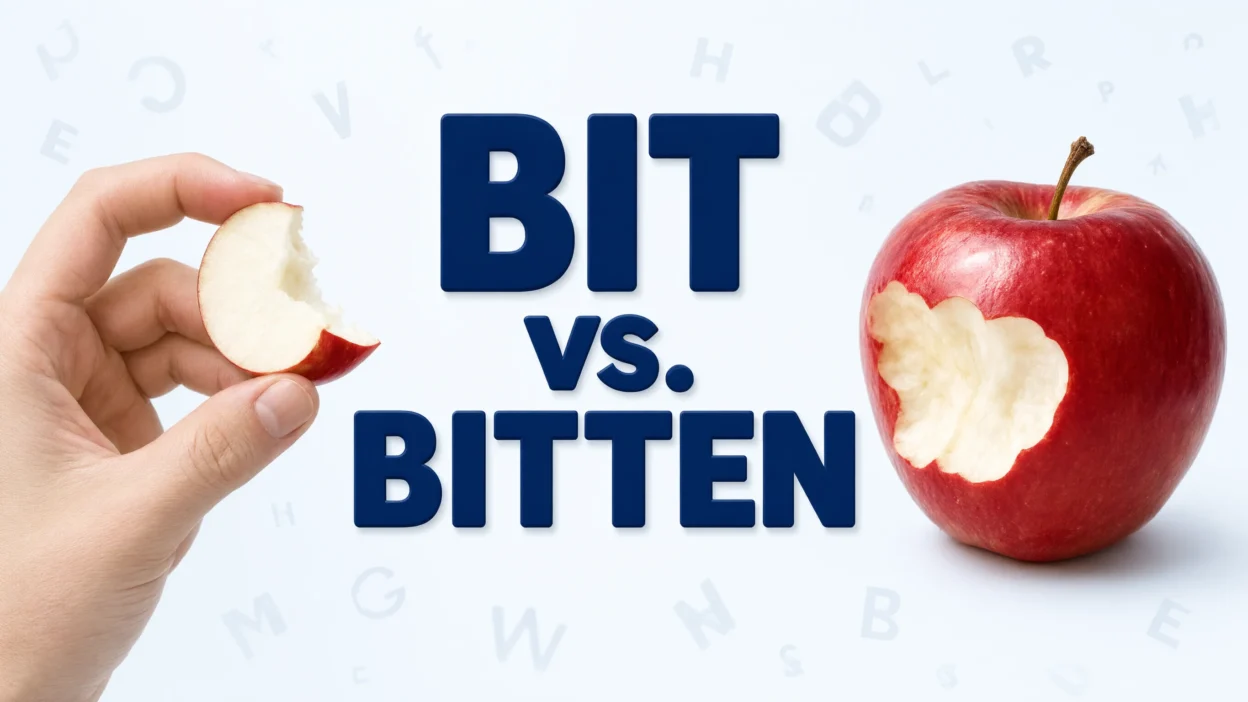
The words bit and bitten are both correct forms of the verb bite, but they are used differently in English. If you have ever wondered if to say “He bit me” or “He has bitten me,” understanding their grammatical roles will help you choose the correct word. The difference is simple once you learn how regular and irregular verb forms work.
Bit is the simple past tense of bite, while bitten is the past participle. We use bit to describe a completed action in the past, usually without an auxiliary verb. We use bitten with helping verbs such as has, have, or had.
Both forms describe the same basic action, but they appear in different sentence structures. In this guide, you will learn their meanings, grammatical differences, examples, common mistakes, and easy ways to remember when to use each word.
Quick Answer: Bit or Bitten?
Bit is the simple past tense of bite, while bitten is its past participle. Use bit for a completed action in the past: “The dog bit my hand.” Use bitten with helping verbs: “The dog has bitten my hand.” Both are correct, but their grammatical uses are different.
Why Do People Confuse Bit and Bitten?
People often confuse bit and bitten because both words describe an action that happened in the past.
The confusion also comes from irregular verbs. Unlike regular verbs, which usually form their past tense by adding -ed, the verb bite changes its form.
For example:
- Present: I bite my nails.
- Past: I bit my nails.
- Past participle: I have bitten my nails.
The main difference is that bit works as a simple past verb, whereas bitten generally needs a helping verb when forming perfect tenses.
What Does Bit Mean?
Bit is the simple past tense of the verb bite. It describes an action that happened and was completed in the past.
The verb bite means to cut, grip, or injure something using the teeth. It can describe people, animals, insects, and even certain objects or situations.
Examples of Bit in Sentences:
- The dog bit the stranger yesterday.
- My little brother bit his finger.
- A mosquito bit me last night.
- She bit into a fresh apple.
- The snake bit the farmer.
In each sentence, bit describes an action that happened in the past.
When Should You Use Bit?
Use bit when:
- You are describing a completed past action.
- You are talking about something that happened yesterday, last week, or earlier.
- You are using the simple past tense without a perfect-tense helping verb.
Example: The little boy bit his sandwich.
What Does Bitten Mean?
Bitten is the past participle of the verb bite. It is commonly used with helping verbs such as has, have, and had to form perfect tenses.
It can also be used as an adjective or in passive constructions.
Examples of Bitten in Sentences:
- The dog has bitten my shoe.
- I have bitten my tongue.
- She had bitten her lip before answering.
- Several people have been bitten by mosquitoes.
- The bitten apple was left on the table.
In these examples, bitten appears with a helping verb or describes something that received the action.
When Should You Use Bitten?
Use bitten when:
- You are forming the present perfect tense.
- You are forming the past perfect tense.
- You are using passive voice.
- You are describing something that has received a bite.
Example: The child has bitten his fingernails.
Bit vs Bitten: What Is the Difference?
The main difference between bit and bitten is their grammatical function. Bit is the simple past form, while bitten is the past participle.
| Feature | Bit | Bitten |
| Base verb | Bite | Bite |
| Verb form | Simple past | Past participle |
| Main use | Past actions | Perfect tenses and passive voice |
| Helping verb | Usually not needed | Usually needed in perfect tenses |
| Example | He bit me. | He has bitten me. |
| Correctness | Correct | Correct |
Remember that both words are correct. Your choice depends on the sentence structure.
When Should You Use Bit or Bitten?
Choosing between these two words becomes easier when you understand the tense of your sentence.
Use Bit for Simple Past Tense
Use bit when talking about an action that happened in the past.
Examples:
- The puppy bit my shoe.
- He bit his tongue while eating.
- The snake bit the traveler.
Use Bitten with Has, Have, or Had
Use bitten when forming perfect tenses.
Examples:
- She has bitten her nails.
- I have bitten into this apple before.
- The dog had bitten the visitor.
Use Bitten in Passive Voice
Use bitten when the subject receives the biting action.
Examples:
- I was bitten by a mosquito.
- The child was bitten by a dog.
- Several people have been bitten by insects.
12 Examples of Bit and Bitten in Sentences
The following examples show how to use both forms correctly in everyday English.
Examples Using Bit
- The dog bit the postman yesterday.
- My sister bit her tongue while eating.
- The mosquito bit me during the night.
- He bit into a juicy orange.
- The snake bit the man in the garden.
- The baby bit his toy while playing.
Examples Using Bitten
- I have bitten my nails since childhood.
- She has bitten into the chocolate bar.
- The boy had bitten his lip nervously.
- My father has been bitten by a dog before.
- The apple was bitten by someone.
- The hikers had been bitten by mosquitoes.
These sentences demonstrate how the correct form depends on the tense and structure of the sentence.
Common Mistakes When Using Bit and Bitten
Even experienced English learners sometimes use these words incorrectly. Here are some common mistakes and their corrections.
| Incorrect Sentence | Correct Sentence |
| He bitten me yesterday. | He bit me yesterday. |
| She has bit her tongue. | She has bitten her tongue. |
| I have bit the apple. | I have bitten the apple. |
| The dog had bit him. | The dog had bitten him. |
| I was bit by a mosquito. | I was bitten by a mosquito. |
Important: In some informal varieties of English, especially American English, bit is sometimes used as a past participle. However, bitten is the standard and widely recommended form for formal writing and general English learning.
Easy Memory Trick: How to Remember Bit vs Bitten
Here is a simple trick to remember the difference:
- Bit = Past action: Use it when something happened in the past.
- Bitten = Past participle: Use it with helping verbs such as has, have, and had.
Think of this simple pattern:
Bite → Bit → Bitten
Remember these three examples:
- Today: I bite my nails.
- Yesterday: I bit my nails.
- Before now: I have bitten my nails.
If you remember this pattern, you can easily choose the correct form when writing or speaking English.
Is There a Difference Between American and British English?
The standard grammatical distinction between bit and bitten is the same in both American and British English.
Both varieties generally use:
- Bit as the simple past tense.
- Bitten as the past participle.
Examples:
| American English | British English |
| The dog bit him. | The dog bit him. |
| She has bitten her lip. | She has bitten her lip. |
| I was bitten by a mosquito. | I was bitten by a mosquito. |
There is no major spelling difference between these forms in American and British English.
Although bit sometimes appears as a past participle in informal American speech, bitten remains the standard choice in formal writing.
Similar Words and Irregular Verb Forms
English contains many irregular verbs that change their spelling instead of simply adding -ed.
Here are some useful examples:
| Present | Simple Past | Past Participle |
| Bite | Bit | Bitten |
| Write | Wrote | Written |
| Ride | Rode | Ridden |
| Hide | Hid | Hidden |
| Break | Broke | Broken |
| Speak | Spoke | Spoken |
| Choose | Chose | Chosen |
| Drive | Drove | Driven |
| Give | Gave | Given |
| Forget | Forgot | Forgotten |
Learning these verb patterns can improve your grammar and help you build more accurate sentences.
Final Verdict: Bit or Bitten?
Both bit and bitten are correct English words, but they have different grammatical uses.
- Choose bit when describing a completed action in the simple past tense.
- Choose bitten when using the past participle in perfect tenses, passive voice, or adjective forms.
For example:
- Correct: The dog bit my hand.
- Correct: The dog has bitten my hand.
The easiest way to remember the difference is that bit describes a past action, while bitten is commonly used with helping verbs.
FAQs:
1. Is Bit or Bitten the Correct Past Tense of Bite?
Bit is the correct simple past tense of bite. For example: “The dog bit my leg.” Bitten is the past participle, not the standard simple past form.
2. Is Bitten a Real Word?
Yes, bitten is a correct English word. It is the past participle of bite and is used with helping verbs such as has, have, and had.
Example: “I have bitten my tongue.”
3. Is It I Got Bit or I Got Bitten?
“I got bitten” is the standard form in general English. “I got bit” is also heard in informal American English, but bitten is the safer choice for formal writing.
4. Should I Say He Bit Me or He Has Bitten Me?
Both are correct, but they use different tenses.
- He bit me. (Simple past)
- He has bitten me. (Present perfect)
Use the first for a completed past event and the second when connecting the past action to the present.
5. What Are the Three Forms of Bite?
The three main forms of bite are:
- Present: Bite
- Simple past: Bit
- Past participle: Bitten
Example: “I bite my nails, I bit them yesterday, and I have bitten them before.”
6. Can I Use Bitten Without a Helping Verb?
Yes. Bitten can appear without a helping verb when it functions as an adjective or a participle phrase.
Example: “The bitten apple was on the table.”
However, in perfect tenses, it needs a helping verb.
7. Is Bitten Used in American and British English?
Yes. Both American and British English use bitten as the standard past participle of bite. The simple past form is bit in both varieties.
Remember This
- Bite = Present tense.
- Bit = Simple past tense.
- Bitten = Past participle.
- He bites his nails.
- He bit his nails yesterday.
- He has bitten his nails before.
Always remember the pattern Bite → Bit → Bitten to avoid common grammar mistakes.
Conclusion
Understanding the difference between bit and bitten is easy when you know their grammatical roles. Both words come from the irregular verb bite, but they are used in different sentence structures. Use bit when describing a completed past action and bitten when forming perfect tenses, passive sentences, or adjective phrases.
Keep practicing with simple examples such as “The dog bit me” and “The dog has bitten me.” Learning this three-form verb pattern will help you improve your English grammar, write more confidently, and avoid common mistakes in everyday communication.