
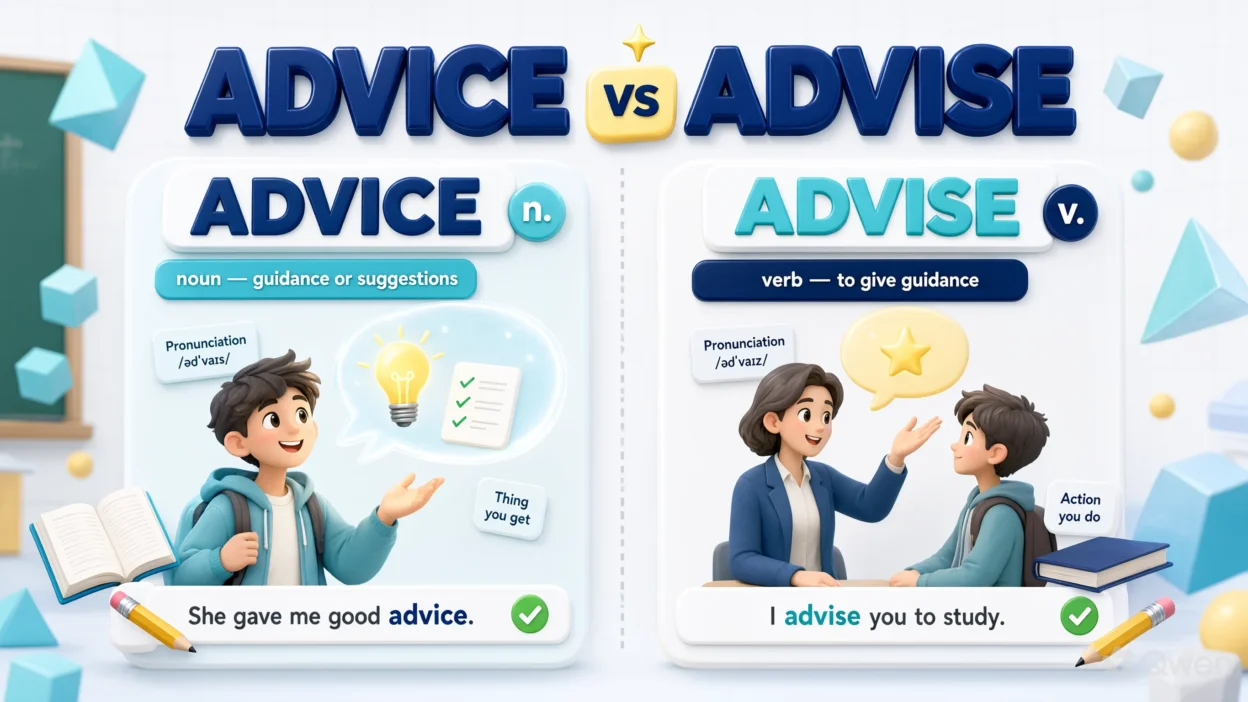
The words advice and advise look and sound very similar, but they have different meanings and grammatical functions. Many English learners, students, and even native speakers confuse these two words when writing emails, essays, messages, or everyday conversations. The main difference is simple: advice is a noun, while advise is a verb.
If you want to tell someone what they should do, you give them advice. If you are recommending, suggesting, or guiding someone toward a decision, you advise them. Understanding this difference will help you avoid common grammar mistakes and use both words naturally.
In this guide, you will learn the meaning of advice and advise, their pronunciation, grammar rules, differences, examples, common mistakes, and easy memory tricks. If you are learning English as a second language or improving your writing, this simple explanation will help you use the correct word confidently.
Quick Answer: Advice or Advise?
Advice is a noun that means a suggestion, recommendation, or guidance about what someone should do. Advise is a verb that means to recommend, guide, or suggest something to someone. Use advice when talking about a recommendation and advise when describing the act of giving that recommendation.
Why Do People Confuse Advice and Advise?
People often confuse advice and advise because the words look almost identical and have closely related meanings. Both words are connected to recommending something or helping someone make a decision.
However, their grammatical roles are different. One names the recommendation, while the other describes the action of making that recommendation.
For example:
- My teacher gave me good advice.
- My teacher advised me to study harder.
In the first sentence, advice is the thing you receive. In the second sentence, advised describes what the teacher did.
Another reason for confusion is pronunciation. The final sound in advice is similar to the /s/ sound, while advise ends with a /z/ sound. Learning this pronunciation difference can help you remember which word to use.
1. What Does Advice Mean?
Advice is a noun that means an opinion, suggestion, recommendation, or guidance offered to help someone make a decision or solve a problem.
It is something a person gives or receives when trying to help another person.
Advice is an uncountable noun, which means you generally do not use a directly before it or make it plural by adding s.
Examples of Advice in Sentences
- My father gave me valuable advice.
- She asked her teacher for advice.
- His advice helped me solve the problem.
- I need some advice about my career.
- They offered me good advice.
- Her financial advice was very helpful.
- He ignored my advice and made a mistake.
How to Use Advice Correctly
Because advice is uncountable, use expressions such as:
- Some advice
- A piece of advice
- A bit of advice
- A lot of advice
- Helpful advice
- Good advice
- Practical advice
Correct:
- She gave me some advice.
- He offered a piece of advice.
- I received a lot of useful advice.
Incorrect:
- She gave me an advice.
- He offered three advices.
Instead, say “a piece of advice” or “three pieces of advice.”
2. What Does Advise Mean?
Advise is a verb that means to recommend something, suggest a course of action, or guide someone about what they should do.
It describes the act of helping someone make a decision by sharing your knowledge, opinion, or experience.
Examples of Advise in Sentences
- I advise you to save your money.
- Doctors advise patients to exercise regularly.
- She advised me to take a short break.
- My parents advise me to work hard.
- The teacher advised him to practice more.
- We advise customers to read the instructions carefully.
- He advised against making a quick decision.
How to Use Advise Correctly
The verb advise can be used in several common sentence patterns.
Advise + someone + to + verb
- I advise you to be careful.
- She advised him to apologize.
- They advised us to leave early.
Advise + against + noun or -ing
- I advise against buying that phone.
- She advised against traveling alone.
- They advised against making unnecessary changes.
Advise + that + clause
- The doctor advised that he rest.
- I advise that everyone arrive early.
- She advised that the matter be discussed privately.
Remember, advise describes an action, so it functions as a verb in a sentence.
Advice vs Advise: Comparison Table
| Feature | Advice | Advise |
|---|---|---|
| Word type | Noun | Verb |
| Meaning | Guidance or recommendation | To recommend or guide |
| Usage | Something you give or receive | The action of giving guidance |
| Pronunciation | /ədˈvaɪs/ | /ədˈvaɪz/ |
| Ending sound | S sound | Z sound |
| Countability | Uncountable noun | Verb |
| Example | I need your advice. | Please advise me. |
| Related forms | Advices (generally incorrect in standard usage) | Advised, advising |
Advice vs Advise Pronunciation
Although the words have similar spelling, their final sounds are different.
- Advice sounds like ad-VICE and ends with an /s/ sound.
- Advise sounds like ad-VIZE and ends with a /z/ sound.
The pronunciation difference is small but useful for identifying which word you need.
When to Use Advice vs Advise
Knowing whether a sentence needs a noun or a verb is the easiest way to choose between these words.
When to Use Advice
Use advice when you are talking about guidance, a recommendation, or an opinion someone gives you.
Examples:
- I need advice about my job.
- Her advice was excellent.
- Can you give me some advice?
- He followed his father’s advice.
- That was a helpful piece of advice.
If the word refers to the guidance itself, use advice.
When to Use Advise
Use advise when someone is giving guidance or recommending an action.
Examples:
- I advise you to study regularly.
- They advise people to eat healthy food.
- My lawyer advised me to wait.
- We advise against using this product.
- Please advise me on what to do.
If the word describes the act of recommending or guiding, use advise.
15 Examples of Advice and Advise in Sentences
Here are practical examples to help you understand the difference in everyday English.
Examples Using Advice
- My mother gave me good advice.
- I need some advice before making a decision.
- His advice helped me find a better job.
- She always gives useful advice to her friends.
- The teacher offered a piece of advice.
- We followed the doctor’s advice.
- His financial advice saved us money.
- Can you give me advice about studying?
Examples Using Advise
- I advise you to work harder.
- She advised me to stay calm.
- The doctor advises patients to drink more water.
- My parents advise me to respect others.
- They advised against going outside.
- I would advise you to think carefully.
- Please advise us on the best option.
Common Mistakes When Using Advice and Advise
Many people make simple mistakes with these words because they do not recognize their grammatical roles.
| Incorrect | Correct |
|---|---|
| She gave me an advise. | She gave me advice. |
| He offered three advices. | He offered three pieces of advice. |
| I advice you to study. | I advise you to study. |
| Please advice me. | Please advise me. |
| My teacher advise me yesterday. | My teacher advised me yesterday. |
| They gave me many advice. | They gave me a lot of advice. |
Mistake 1: Using Advise as a Noun
Incorrect: I need your advise.
Correct: I need your advice.
Why? You need the recommendation itself, so the noun advice is required.
Mistake 2: Using Advice as a Verb
Incorrect: I advice you to work hard.
Correct: I advise you to work hard.
Why? Recommending something is an action, so you need the verb advise.
Mistake 3: Making Advice Plural
Incorrect: She gave me several advices.
Correct: She gave me several pieces of advice.
Why? Advice is an uncountable noun in standard English. Use pieces of advice when counting individual recommendations.
Mistake 4: Forgetting the Past Tense of Advise
Incorrect: He advise me to wait yesterday.
Correct: He advised me to wait yesterday.
Why? When the action happened in the past, the verb advise changes to advised.
Easy Memory Trick to Remember Advice vs Advise
The easiest way to remember these two words is to focus on their final letters.
- Advice with C = Concept. Advice is the guidance or recommendation itself.
- Advise with S = Suggest. Advise is the action of suggesting something.
Another simple trick is to remember:
For example:
- I gave her some advice.
- I advised her to take a break.
If you remember that advice is a thing and advise is an action, you will rarely confuse them.
Advice vs Advise in American and British English
There is no difference in the meaning or grammatical usage of advice and advise between American English and British English. Both varieties use advice as a noun and advise as a verb.
| American English | British English |
|---|---|
| I need your advice. | I need your advice. |
| She advised me to wait. | She advised me to wait. |
| He gave me a piece of advice. | He gave me a piece of advice. |
| Please advise me. | Please advise me. |
The spelling, meanings, and grammatical rules are the same in both varieties.
Similar Words Related to Advice and Advise
Learning words related to advice and advise can help you improve your vocabulary and express yourself more clearly.
| Word | Meaning | Example |
|---|---|---|
| Suggest | Offer an idea | I suggest taking a break. |
| Recommend | Say something is suitable | I recommend this book. |
| Guidance | Help or direction | She gave me guidance. |
| Counsel | Serious or professional advice | He sought legal counsel. |
| Tip | A useful small suggestion | Here is a helpful tip. |
| Opinion | A personal view or belief | In my opinion, you should wait. |
| Advise | Recommend an action | I advise you to be patient. |
| Advice | Guidance or recommendation | Her advice was helpful. |
These words are related, but they are not always interchangeable. For example, counsel often sounds more formal or professional, while tip is usually informal and practical.
Final Verdict: Which One Should You Use?
Both advice and advise are correct words, but you must use them according to their grammatical roles.
- Use advice when referring to a suggestion, recommendation, or guidance.
- Use advise when describing the action of recommending or guiding someone.
Examples:
- I need your advice.
- Please advise me.
- She gave me a piece of advice.
- She advised me to take the job.
If you are unsure, ask yourself whether you are talking about the recommendation itself or the act of giving it. That simple question will help you choose the right word.
FAQs:
1. What Is the Difference Between Advice and Advise?
Advice is a noun that means guidance or a recommendation. Advise is a verb that means to recommend or guide someone. For example, “She gave me advice” and “She advised me to study” are both correct.
2. Is Advice a Noun or a Verb?
Advice is a noun. It refers to a suggestion, recommendation, or guidance that someone gives to help another person. It is an uncountable noun, so you generally say “some advice” rather than “an advice.”
3. Is Advise a Noun or a Verb?
Advise is a verb. It describes the action of recommending, guiding, or suggesting something to someone. For example, “I advise you to be careful” uses advise correctly as a verb.
4. Is It Correct to Say a Piece of Advice?
Yes, “a piece of advice” is grammatically correct. Since advice is uncountable, you use piece to refer to one individual recommendation. You can also say “two pieces of advice” or “several pieces of advice.”
5. How Do You Pronounce Advice and Advise?
Advice ends with an /s/ sound, like “ice.” Advise ends with a /z/ sound, like “eyes.” Their pronunciation is similar, but the final sound helps distinguish the noun from the verb.
6. Is It Correct to Say Please Advice Me?
No, “Please advice me” is incorrect in standard English. The correct sentence is “Please advise me.” You need the verb advise because you are asking someone to give you guidance.
7. What Is the Past Tense of Advise?
The past tense of advise is advised. For example, “My teacher advised me to practice every day.” The spelling changes from advise to advised, but the meaning remains related to giving guidance or recommendations.
Remember This
- Advice = noun (guidance or recommendation).
- Advise = verb (to recommend or guide).
- Advice is uncountable.
- Say “some advice,” not “an advice.”
- Say “a piece of advice” when referring to one recommendation.
- Advise ends with a /z/ sound.
- Advice ends with an /s/ sound.
- The past tense of advise is advised.
Conclusion
The difference between advice and advise is easy to understand once you learn their grammatical roles. Advice is a noun that refers to guidance or a recommendation, while advise is a verb that describes giving that guidance. Although they look similar, they perform different jobs in a sentence. Using them correctly will make your English writing clearer, more accurate, and more natural.
Whenever you are unsure which word to use, remember that advice is something you receive, while advise is something you do. Practice with simple sentences such as “She gave me advice” and “She advised me to study.” With a little practice, you will be able to use both words confidently in conversations, emails, essays, and everyday writing.


