
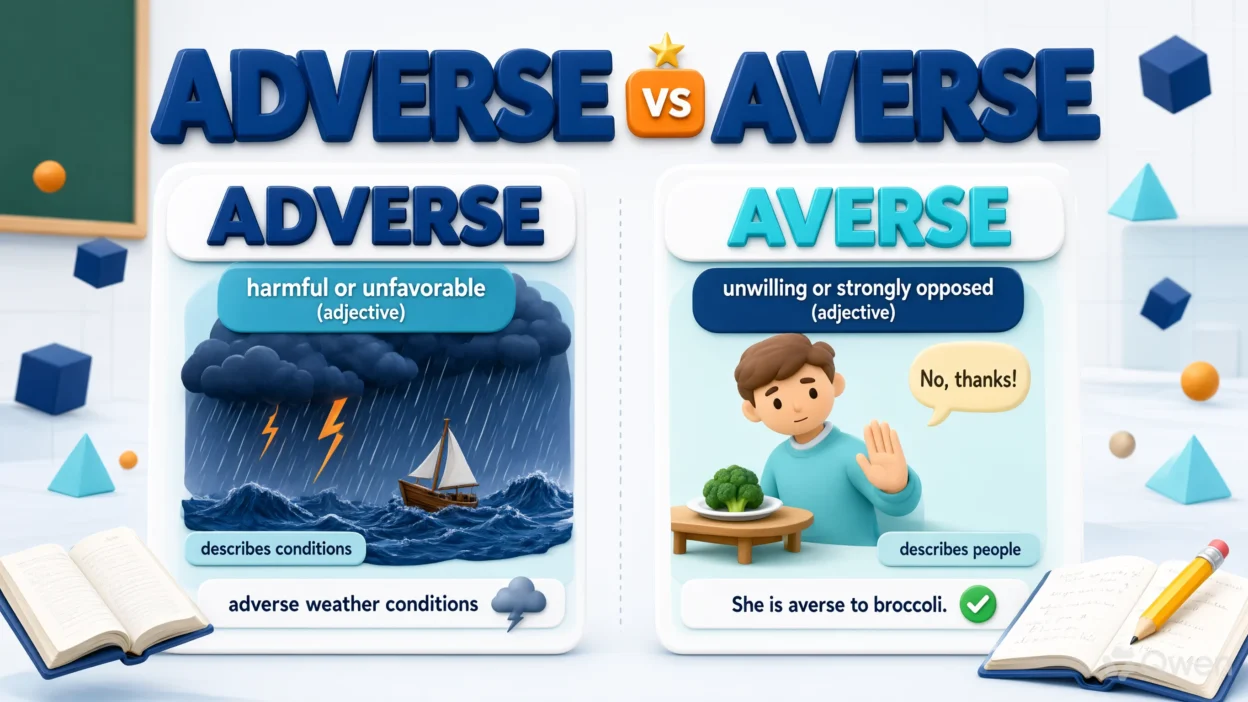
The words adverse and averse look and sound similar, but they have different meanings and uses in English. Adverse describes something harmful, unfavorable, or negative, while averse describes a person who is unwilling, opposed, or reluctant to do something. Understanding the difference between adverse and averse can help you avoid common grammar mistakes and express your ideas more clearly.
These two words are often confused because they share similar spelling and pronunciation. However, they are used in different contexts. You might experience adverse if conditions, but you might be averse to driving in bad weather. One word describes a negative situation, while the other describes a person’s attitude toward something.
In this guide, you will learn the meaning of adverse and averse, their grammatical differences, when to use each word, common mistakes, and easy examples to help you remember them correctly.
Quick Answer: Adverse or Averse?
Adverse means harmful, unfavorable, or negative, usually describing conditions, effects, circumstances, or outcomes. Averse means unwilling, reluctant, or opposed to something, usually describing a person’s attitude. For example, adverse effects means harmful effects, while averse to risk means unwilling to take risks.
Why Do People Confuse Adverse and Averse?
People often confuse adverse and averse because the two words look almost identical. Both contain similar letters, have a related pronunciation, and are associated with negative situations or feelings.
However, the key difference is what they describe:
- Adverse describes something unfavorable or harmful.
- Averse describes someone’s dislike, reluctance, or opposition.
For example:
- The company faced adverse conditions during the economic crisis.
- The company was averse to taking risks.
In the first sentence, adverse describes unfavorable conditions. In the second sentence, averse describes an attitude toward risk.
Remember that these words are not interchangeable, even though they are closely related in meaning.
1. What Does Adverse Mean?
Adverse is an adjective that means harmful, unfavorable, negative, or likely to cause problems. It is commonly used to describe circumstances, effects, conditions, reactions, or situations that make something more difficult or less successful.
The word is often used in formal, professional, medical, legal, business, and academic English.
Examples of Adverse in Sentences
- The hikers faced adverse weather conditions.
- The medication may cause adverse effects.
- The business suffered due to adverse economic conditions.
- Heavy rain had an adverse impact on traffic.
- The decision could have adverse consequences.
- The team performed well despite adverse circumstances.
- Pollution can have adverse effects on human health.
When to Use Adverse
Use adverse when describing:
- Harmful effects
- Unfavorable circumstances
- Negative outcomes
- Difficult conditions
- Problems or consequences
Common Phrases With Adverse
| Phrase | Meaning |
|---|---|
| Adverse effects | Harmful or unwanted effects |
| Adverse conditions | Unfavorable circumstances |
| Adverse weather | Bad or difficult weather |
| Adverse consequences | Negative results |
| Adverse reaction | An unwanted response |
| Adverse impact | A harmful influence |
| Adverse circumstances | Difficult situations |
Example: The workers continued their duties despite adverse conditions.
Here, adverse means difficult or unfavorable.
2. What Does Averse Mean?
Averse is an adjective that means unwilling, reluctant, or strongly opposed to something. It describes a person’s feelings, preferences, or attitude toward an action, idea, experience, or situation.
It is often used with the preposition to, making the common phrase averse to.
Examples of Averse in Sentences
- She is averse to taking unnecessary risks.
- He is averse to public speaking.
- They are averse to spending too much money.
- My brother is averse to eating spicy food.
- I am not averse to trying something new.
- Some people are averse to change.
- She was averse to discussing the problem.
When to Use Averse
Use averse when describing:
- Someone’s unwillingness to do something
- A person’s dislike of an activity
- Opposition to an idea
- Reluctance to accept change
- A negative attitude toward a choice
Common Phrases With Averse
| Phrase | Meaning |
|---|---|
| Averse to risk | Unwilling to take risks |
| Averse to change | Reluctant to accept change |
| Averse to spending | Unwilling to spend money |
| Averse to conflict | Uncomfortable with disagreements |
| Averse to exercise | Unwilling to exercise |
| Risk-averse | Cautious about taking risks |
Example: He is averse to working late.
Here, averse describes his unwillingness to work late.
Adverse vs Averse: Comparison Table
| Feature | Adverse | Averse |
|---|---|---|
| Meaning | Harmful or unfavorable | Unwilling or opposed |
| Part of speech | Adjective | Adjective |
| Describes | Conditions, effects, outcomes | Attitudes, preferences, people |
| Common usage | Adverse effects | Averse to something |
| Common context | Health, business, weather, law | Choices, behavior, opinions |
| Example | Adverse weather delayed the flight. | She is averse to flying. |
| Synonyms | Harmful, unfavorable, negative | Reluctant, opposed, unwilling |
The easiest way to understand the difference is to remember that adverse describes a negative situation, while averse describes a negative attitude toward something.
When to Use Adverse vs Averse
Choosing the correct word becomes easier when you focus on the meaning of your sentence.
When to Use Adverse
Use adverse when you want to describe something that causes harm, creates difficulty, or produces an unfavorable result.
Examples:
- The storm created adverse weather conditions.
- The treatment may have adverse effects.
- The company experienced adverse financial results.
- The policy had an adverse impact on employees.
- The road conditions were adverse.
Ask yourself: Is something harmful, negative, or unfavorable?
If yes, adverse is probably the correct word.
When to Use Averse
Use averse when you want to describe someone who does not want to do something or who opposes a particular activity, decision, or idea.
Examples:
- She is averse to traveling alone.
- He is averse to taking financial risks.
- They are averse to changing their plans.
- I am averse to unnecessary arguments.
- My parents are averse to wasting food.
Ask yourself: Is someone unwilling, reluctant, or opposed to something?
If yes, averse is likely the correct word.
15 Examples of Adverse and Averse in Sentences
These examples show how both words are used naturally in everyday and professional English.
Examples Using Adverse
- The flight was delayed because of adverse weather conditions.
- Smoking can have adverse effects on your health.
- The company faced adverse economic conditions.
- The new policy had an adverse impact on employees.
- The medicine caused an adverse reaction in the patient.
- The team continued playing despite adverse circumstances.
- Heavy rainfall created adverse road conditions.
- The decision may lead to adverse consequences.
Examples Using Averse
- She is averse to taking unnecessary risks.
- He is averse to speaking in front of large crowds.
- My sister is averse to eating seafood.
- They are averse to spending money on unnecessary things.
- I am not averse to learning new skills.
- Many people are averse to sudden changes.
- He is averse to discussing personal matters.
Notice how adverse describes something unfavorable, while averse describes a person’s reluctance or opposition.
Common Mistakes When Using Adverse and Averse
Because these words look similar, writers sometimes use the wrong one. Here are common mistakes and their corrections.
| Incorrect | Correct |
|---|---|
| She is adverse to taking risks. | She is averse to taking risks. |
| The patient experienced a averse reaction. | The patient experienced an adverse reaction. |
| He is adverse to change. | He is averse to change. |
| The storm created averse conditions. | The storm created adverse conditions. |
| We faced averse circumstances. | We faced adverse circumstances. |
| She had an adverse attitude toward exercise. | She had an averse attitude toward exercise. |
Mistake 1: Using Adverse for a Person’s Reluctance
Incorrect: He is adverse to public speaking.
Correct: He is averse to public speaking.
Why? The sentence describes his unwillingness to speak in public, so averse is the correct word.
Mistake 2: Using Averse for Harmful Effects
Incorrect: The drug caused a averse effect.
Correct: The drug caused an adverse effect.
Why? The sentence describes a negative or unwanted effect, so adverse is needed.
Mistake 3: Forgetting the Preposition To
Incorrect: She is averse spending money.
Correct: She is averse to spending money.
Why? The common grammatical pattern is averse to followed by a noun or gerund (verb ending in -ing).
Easy Memory Trick to Remember Adverse vs Averse
Here is a simple way to remember the difference:
ADVERSE = Bad Conditions
Think of ADVERSE effects, weather, conditions, or consequences.
Adverse = Something negative or harmful.
AVERSE = Avoid Something
Think of a person who wants to avoid something.
Averse = Unwilling or opposed.
Remember These Two Sentences
- Adverse: The adverse weather made the journey difficult.
- Averse: She is averse to traveling in bad weather.
The weather is unfavorable, so use adverse. The person is unwilling to travel, so use averse.
Adverse vs Averse in American and British English
There is no meaningful spelling or usage difference between adverse and averse in American and British English. Both words have the same meanings and grammatical functions in the two varieties.
| American English | British English |
|---|---|
| Adverse weather | Adverse weather |
| Adverse effects | Adverse effects |
| Averse to change | Averse to change |
| Averse to risk | Averse to risk |
Both American and British English speakers use adverse for harmful or unfavorable situations and averse for reluctance or opposition.
These words are standard in both varieties of English.
Similar Words Related to Adverse and Averse
Learning related words can help you expand your vocabulary and better understand how to use adverse and averse.
| Word | Meaning | Example |
|---|---|---|
| Adversity | Difficulty or hardship | She overcame adversity. |
| Adversely | In a harmful or unfavorable way | The change affected sales adversely. |
| Adversarial | Opposing or hostile | They had an adversarial relationship. |
| Aversion | A strong dislike | He has an aversion to crowds. |
| Aversive | Causing avoidance or dislike | The experience was aversive. |
| Reluctant | Unwilling or hesitant | She was reluctant to answer. |
| Opposed | Against something | They opposed the proposal. |
| Unfavorable | Not positive or beneficial | The review was unfavorable. |
Adverse vs Adversity
Adverse is an adjective meaning unfavorable or harmful, while adversity is a noun meaning hardship or difficulty.
- Adverse: They faced adverse conditions.
- Adversity: They overcame adversity.
Averse vs Aversion
Averse is an adjective describing unwillingness or dislike, while aversion is a noun describing a strong dislike.
- Averse: He is averse to heights.
- Aversion: He has an aversion to heights.
Final Verdict: Which Word Should You Use?
Both adverse and averse are correct words, but they serve different purposes.
Use adverse when describing harmful, unfavorable, or negative conditions, effects, circumstances, or outcomes.
Example: The medication had adverse effects.
Use averse when describing someone who is unwilling, reluctant, or opposed to something.
Example: She is averse to taking risks.
If you are talking about a bad situation, choose adverse. If you are talking about someone’s unwillingness to do something, choose averse.
FAQs:
1. What Is the Main Difference Between Adverse and Averse?
Adverse means harmful, unfavorable, or negative, while averse means unwilling, reluctant, or opposed to something. Adverse describes a situation or effect, whereas averse describes someone’s attitude or preference.
2. Is It Adverse to or Averse to?
The correct phrase for describing reluctance is averse to. For example, “He is averse to taking risks.” Adverse is generally used before nouns, as in “adverse conditions” or “adverse effects.”
3. Can Adverse and Averse Be Used Interchangeably?
No. Although they look similar, they have different meanings. Adverse describes negative conditions or consequences, while averse describes unwillingness or opposition. Using one in place of the other can change the meaning or make a sentence grammatically incorrect.
4. Is Adverse a Negative Word?
Yes. Adverse generally has a negative meaning because it describes harmful, unfavorable, or undesirable conditions, effects, or outcomes.
5. What Does Averse to Mean?
Averse to means unwilling to do something, uncomfortable with something, or opposed to something. For example, “I am averse to wasting time” means that I dislike or do not want to waste time.
6. What Is the Difference Between Adverse and Adversity?
Adverse is an adjective meaning unfavorable or harmful, while adversity is a noun referring to hardship, difficulty, or an unpleasant situation. For example, “adverse conditions” describes difficult conditions, while “overcoming adversity” means overcoming hardships.
7. What Is the Difference Between Averse and Aversion?
Averse is an adjective that describes someone who is unwilling or opposed to something. Aversion is a noun meaning a strong dislike. For example, “She is averse to crowds” and “She has an aversion to crowds.”
Remember This
- Adverse = Harmful, unfavorable, or negative.
- Averse = Unwilling, reluctant, or opposed.
- Adverse weather = Unfavorable weather.
- Adverse effects = Harmful effects.
- Averse to risk = Unwilling to take risks.
- Averse to change = Reluctant to accept change.
- Use adverse to describe conditions or consequences.
- Use averse to describe attitudes or preferences.
Conclusion
Understanding the difference between adverse and averse is easy once you focus on what each word describes. Adverse refers to something harmful, unfavorable, or negative, such as adverse weather, adverse effects, or adverse circumstances. It is commonly used when talking about problems, risks, or undesirable outcomes.
On the other hand, averse describes a person’s unwillingness, reluctance, or opposition to something. Phrases such as averse to change, averse to risk, and averse to spending are common examples. Remember that adverse describes a bad situation, while averse describes a person who wants to avoid something.
Learning this simple distinction will help you use both words correctly in everyday conversations, academic writing, and professional communication.

Evelyn Mia is a passionate language writer and vocabulary enthusiast at Synomity.com, specializing in synonyms, word meanings, and language learning. She creates informative content that helps readers expand vocabulary and communicate more effectively.


