
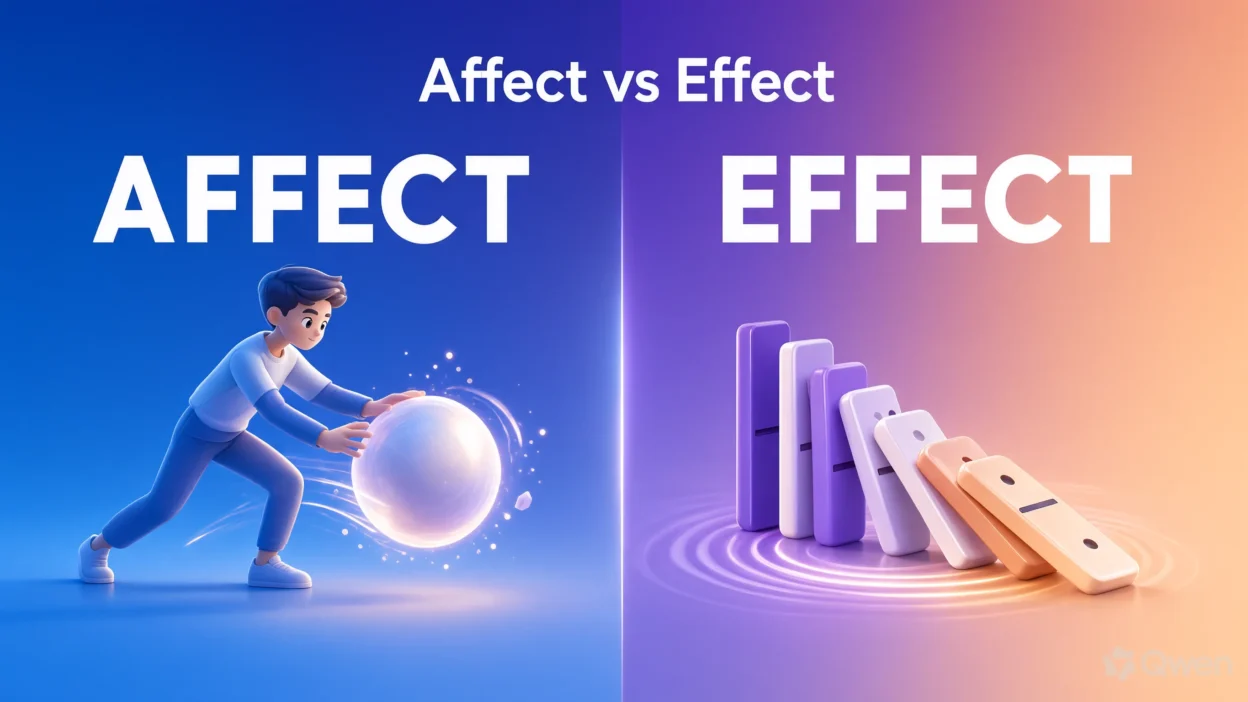
The words affect and effect are among the most commonly confused words in English. They look similar, sound similar, and are often used in the same types of sentences, but they have different meanings and grammatical roles. In most cases, affect is a verb meaning to influence something, while effect is a noun meaning a result or consequence.
For example, you can say, “Lack of sleep can affect your concentration,” or “Lack of sleep can have an effect on your concentration.” Both sentences are correct, but they use different grammatical structures. Understanding this difference can help you write more clearly, avoid common grammar mistakes, and communicate confidently in school, work, and everyday conversations.
In this guide, you will learn the meanings of affect and effect, their differences, when to use each word, practical examples, common mistakes, and simple memory tricks to remember them forever.
Quick Answer: Affect or Effect?
Affect is usually a verb meaning to influence, change, or make a difference to something. Effect is usually a noun meaning the result or consequence of an action. For example, “The weather affects our mood” and “The weather has an effect on our mood.” Affect describes the influence; effect describes the result.
Why Do People Confuse Affect and Effect?
People confuse affect and effect because they sound almost identical and are often used when discussing changes, results, experiences, and consequences.
Both words are connected to the idea of something happening because of another thing. However, they play different roles in a sentence.
- Affect explains what something influences or changes.
- Effect identifies the result of that influence or change.
For example:
- The new schedule affects our daily routine.
- The new schedule has an effect on our daily routine.
In the first sentence, affects describes the action of influencing. In the second sentence, effect refers to the result or impact.
The easiest way to avoid confusion is to understand whether your sentence needs an action word or a result-related noun.
1. What Does Affect Mean?
Affect is most commonly used as a verb meaning to influence, change, or have an impact on someone or something.
It describes an action in which one thing makes a difference to another thing. The change may be positive, negative, emotional, physical, social, or practical.
Examples of Affect in Sentences
- Lack of sleep can affect your health.
- The weather affects my mood.
- Rising prices affect families.
- Her decision affected everyone.
- Stress can affect your performance.
- The news affected him deeply.
- Noise affects my concentration.
When to Use Affect
Use affect when you want to describe:
- Influencing someone’s behavior
- Changing a situation
- Impacting health or emotions
- Making a difference to a result
- Altering someone’s performance or condition
Common Phrases With Affect
| Phrase | Example |
| Affect health | Smoking can affect your health. |
| Affect mood | Rainy weather affects my mood. |
| Affect performance | Stress affects performance. |
| Affect behavior | Parenting can affect behavior. |
| Affect decisions | Emotions affect our decisions. |
| Affect results | Poor planning affects results. |
Example: Heavy traffic affected my arrival time.
In this sentence, affected is a verb describing how traffic influenced the time I arrived.
2. What Does Effect Mean?
Effect is most commonly a noun meaning a result, consequence, outcome, or change caused by something.
It describes what happens because of an action, event, decision, or condition. An effect can be positive, negative, immediate, or long-term.
Examples of Effect in Sentences
- The medicine had a positive effect on her health.
- The storm caused serious effects in the region.
- The new policy had an effect on employees.
- Exercise has many beneficial effects.
- The noise had a negative effect on my concentration.
- The decision produced an unexpected effect.
- The effects of stress can be harmful.
When to Use Effect
Use effect when you want to describe:
- A result of an action
- A consequence of a decision
- A change caused by something
- An outcome of an event
- The impact of a situation
Common Phrases With Effect
| Phrase | Meaning |
| Have an effect on | Influence or impact something |
| Positive effect | Beneficial result |
| Negative effect | Harmful result |
| Side effect | Additional, often unwanted result |
| Cause and effect | Relationship between an action and its result |
| Take effect | Begin to produce results or become active |
| In effect | In practice or currently operating |
Example: The medicine had a positive effect on my sleep.
Here, effect is a noun referring to the result of taking the medicine.
Affect vs Effect: Comparison Table
| Feature | Affect | Effect |
| Most common part of speech | Verb | Noun |
| Meaning | To influence or change | A result or consequence |
| Describes | An action | An outcome |
| Common usage | Affect someone’s mood | Have an effect on someone |
| Synonyms | Influence, impact, alter | Result, outcome, consequence |
| Example | Noise affects my focus. | Noise has an effect on my focus. |
| Question to ask | What is influencing something? | What is the result? |
Affect vs Effect: Verb and Noun Forms
| Word | Form | Meaning |
| Affect | Verb | To influence |
| Affected | Past tense | Influenced |
| Affecting | Present participle | Influencing |
| Effect | Noun | Result |
| Effects | Plural noun | Results |
| Effective | Adjective | Producing a desired result |
| Effectively | Adverb | In a successful or useful way |
Remember that affect is usually an action, while effect is usually the result of an action.
When to Use Affect vs Effect
Choosing the correct word becomes easier when you understand how it functions in your sentence.
When to Use Affect
Use affect when you want to describe something influencing or changing another thing.
Examples:
- The cold weather affects my skin.
- Social media affects people’s opinions.
- Poor sleep affects your energy levels.
- The new rules affect all students.
- Her words affected me emotionally.
Ask yourself: Is something influencing or changing something else?
If yes, affect is usually the correct word.
When to Use Effect
Use effect when you want to identify the result or consequence of something.
Examples:
- The cold weather had an effect on my skin.
- Social media has an effect on people’s opinions.
- Poor sleep has an effect on your energy levels.
- The new rules had an effect on all students.
- Her words had a powerful effect on me.
Ask yourself: Am I talking about a result or consequence?
If yes, effect is usually the correct word.
Affect or Effect After The, An, or A?
A useful grammar clue is the word that comes before it.
- An effect is a common noun phrase.
- The effect is a common noun phrase.
- Can affect is a common verb phrase.
- Will affect is a common verb phrase.
- May affect is a common verb phrase.
Examples:
- The change had an effect on sales.
- This decision may affect sales.
- The treatment can affect your appetite.
- The treatment had a positive effect on your appetite.
This clue is helpful, although it is not a substitute for understanding the sentence.
15 Examples of Affect and Effect in Sentences
Here are 15 practical examples to help you understand the difference between these two words.
Examples Using Affect
- Lack of exercise can affect your physical health.
- The rain affected our travel plans.
- Her attitude affects the whole team.
- Stress can affect your memory.
- The price increase affected many customers.
- Music affects my mood.
- The decision will affect our future.
- His speech affected the audience emotionally.
Examples Using Effect
- Exercise has a positive effect on your health.
- The rain had an effect on our travel plans.
- Her attitude had an effect on the team.
- Stress can have an effect on your memory.
- The price increase had an effect on customers.
- Music has a powerful effect on my mood.
- His speech had a lasting effect on the audience.
These examples demonstrate how the same idea can be expressed using affect as a verb or effect as a noun.
Common Mistakes When Using Affect and Effect
Even experienced writers sometimes mix up these words. Here are some common mistakes and their corrections.
| Incorrect Sentence | Correct Sentence |
| The weather had an affect on us. | The weather had an effect on us. |
| Stress can effect your health. | Stress can affect your health. |
| The changes will effect everyone. | The changes will affect everyone. |
| It had a positive affect. | It had a positive effect. |
| This may have an affect on sales. | This may have an effect on sales. |
| Noise has a negative affect on sleep. | Noise has a negative effect on sleep. |
Mistake 1: Using Effect as a Verb Meaning Influence
Incorrect: The news will effect my mood.
Correct: The news will affect my mood.
Why? You mean that the news will influence your mood, so affect is the correct verb.
Mistake 2: Using Affect as a Noun Meaning Result
Incorrect: The medicine had a good affect.
Correct: The medicine had a good effect.
Why? You are describing a result, so you need the noun effect.
Mistake 3: Confusing Affect and Effect in Academic Writing
Incorrect: The study examined how pollution effects human health.
Correct: The study examined how pollution affects human health.
Why? Pollution is influencing health, so affects is the verb you need.
Easy Memory Trick to Remember Affect vs Effect
Here is a simple memory trick that makes these words easier to remember.
A = Affect = Action
Think of Affect as an action that influences or changes something.
Affect = Influence
E = Effect = End Result
Think of Effect as the end result or outcome of an action.
Effect = Result
Remember This Simple Formula
Cause → Affect → Effect
Example:
Lack of sleep affects your concentration, and the effect is that you make more mistakes.
Another helpful trick is to remember:
- Affect = Action
- Effect = End result
This simple association will help you choose the correct word in most everyday situations.
Affect vs Effect in American and British English
There is no meaningful spelling or grammatical difference between affect and effect in American and British English. Both varieties use the words in the same way in ordinary writing and conversation.
| American English | British English |
| Stress affects health. | Stress affects health. |
| The effect was noticeable. | The effect was noticeable. |
| It had a negative effect. | It had a negative effect. |
| The decision affects everyone. | The decision affects everyone. |
Both American and British English speakers use affect as a verb meaning influence and effect as a noun meaning result.
These words are standard in both varieties of English.
Similar Words Related to Affect and Effect
Learning related words can help you build vocabulary and understand how these words work in different situations.
| Word | Meaning | Example |
| Influence | The power to change something | Her advice influenced my decision. |
| Impact | A strong effect or influence | The policy had a major impact. |
| Consequence | A result of an action | Every decision has consequences. |
| Outcome | The final result | The outcome was positive. |
| Result | Something that happens because of an action | Hard work produced results. |
| Alter | To change something | The plan was altered. |
| Modify | To make a change | We modified the schedule. |
| Effective | Producing a desired result | The treatment was effective. |
| Effectively | In a successful way | She communicated effectively. |
| Affected | Influenced or changed | The affected areas were evacuated. |
Affect vs Impact
Affect is generally used as a verb meaning to influence something, while impact can be used as both a noun and a verb.
- Affect: The decision affects our business.
- Impact: The decision has an impact on our business.
- Impact (verb): The decision impacted our business.
Affect vs Influence
Both words can describe the act of changing or shaping something.
- Affect: The weather affects my mood.
- Influence: The weather influences my mood.
Influence may sometimes suggest a gradual or indirect effect, but in many sentences, the two words are interchangeable.
Final Verdict: Which Word Should You Use?
Both affect and effect are correct words, but they have different grammatical roles and meanings.
Use affect when you mean to influence, change, or make a difference to something.
Example: Lack of sleep can affect your performance.
Use effect when you mean a result, consequence, or outcome.
Example: Lack of sleep can have an effect on your performance.
If you are describing an action that causes a change, choose affect. If you are describing the result of that change, choose effect.
FAQs:
1. What Is the Main Difference Between Affect and Effect?
Affect is usually a verb meaning to influence or change something, while effect is usually a noun meaning the result or consequence of something. For example, “Stress affects sleep” and “Stress has an effect on sleep.”
2. Is Affect a Verb or a Noun?
Affect is most commonly used as a verb. It means to influence, change, or have an impact on something. For example, “The weather affects my mood.” In psychology, affect can also be a noun referring to an observable emotional response.
3. Is Effect a Verb or a Noun?
Effect is most commonly used as a noun meaning a result or consequence. However, it can also be used as a verb meaning to bring about or accomplish something, as in “The government hopes to effect change.”
4. How Do I Remember Affect vs Effect?
Remember Affect = Action and Effect = End result. Affect is usually the action of influencing something, while effect is the outcome of that influence. For example, exercise affects your body, and the effect may be improved health.
5. Is It Affect My Life or Effect My Life?
The correct phrase in most situations is “affect my life” because you mean something influences or changes your life. For example, “Your choices affect your life.” You would use effect as a noun in a sentence such as “Your choices have an effect on your life.”
6. Can Effect Be Used as a Verb?
Yes. Effect can be used as a verb meaning to bring about, cause, or accomplish something. For example, “The new manager hopes to effect positive changes.” This usage is more formal and less common than effect as a noun.
7. What Is an Example of Affect and Effect in the Same Sentence?
“Regular exercise affects your health, and its effect is often improved strength and fitness.”
In this sentence, affects is a verb describing influence, while effect is a noun describing the result.
Remember This
- Affect = To influence, change, or make a difference.
- Effect = A result, outcome, or consequence.
- Affect is usually a verb.
- Effect is usually a noun.
- Stress can affect your health.
- Stress can have an effect on your health.
- A = Affect = Action.
- E = Effect = End result.
Conclusion
Understanding the difference between affect and effect is easier when you focus on their grammatical roles. Affect is generally a verb that describes influencing or changing something, while effect is generally a noun that describes the result of an action. Although both words are connected to the idea of change, they are not interchangeable in most sentences.
Remember the simple rule: affect is the action, and effect is the result. When you say something affects your life, you mean it influences your life. When you say something has an effect on your life, you are describing the result of that influence. Practicing these words with everyday examples will help you use them confidently in conversations, essays, emails, and professional writing.


