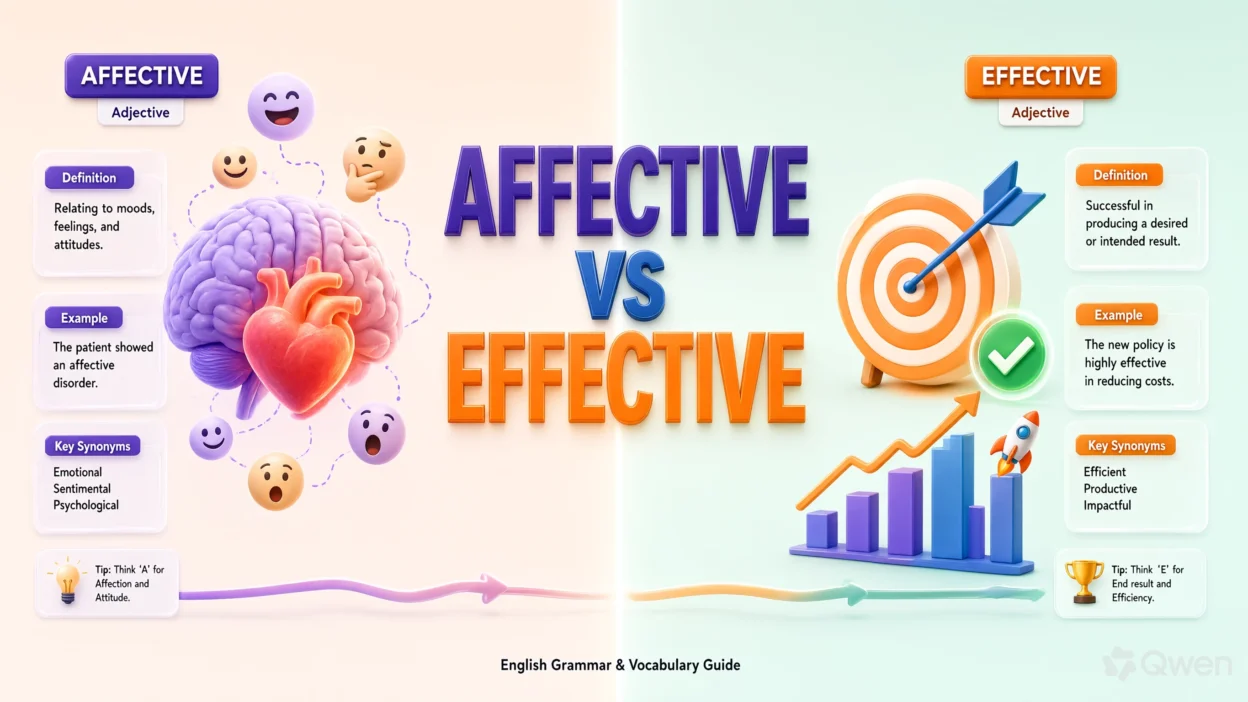
The words affective and effective look and sound similar, but they have very different meanings. Affective relates to emotions, feelings, moods, and emotional responses, while effective means successful in producing a desired result. Understanding the difference between affective or effective is important for students, writers, professionals, and anyone who wants to improve their English vocabulary.
People often confuse these words because they share similar spelling and pronunciation. However, using the wrong word can change the meaning of an entire sentence. For example, an affective response describes an emotional reaction, whereas an effective response describes a response that works well or achieves a goal.
In this guide, you will learn what affective and effective mean, how they differ, when to use each word, and how to remember them easily. You will also find practical examples, common mistakes, and simple explanations to help you use both words correctly in everyday English.
Quick Answer: Affective or Effective?
Affective relates to emotions, feelings, moods, or emotional experiences. Effective means successful, useful, or capable of producing the intended result. Use affective when discussing emotional reactions and effective when describing something that works well. For example, an affective response involves feelings, while an effective solution solves a problem.
Why Do People Confuse Affective and Effective?
People confuse affective and effective because the two words look almost identical and sound similar when spoken. Both contain the letters “fective,” making it easy to choose the wrong spelling when writing quickly.
However, their meanings are completely different.
- Affective is connected to emotions, feelings, and emotional experiences.
- Effective is connected to success, results, performance, and achieving goals.
The confusion is particularly common in academic writing, psychology, education, business communication, and everyday English because both words can appear in similar sentence structures.
For example:
- The teacher used an affective approach to understand students’ emotions.
- The teacher used an effective approach to improve students’ performance.
Both sentences are grammatically correct, but they communicate different ideas.
1. What Does Affective Mean?
Affective is an adjective that describes something related to emotions, feelings, moods, attitudes, or emotional responses.
It is commonly used in psychology, education, healthcare, and social sciences when discussing how people feel or emotionally react to situations.
Examples of Affective in Sentences
- The movie created a strong affective response in the audience.
- Affective learning helps students develop emotional awareness.
- The child’s affective needs are important for healthy development.
- Music can have a powerful affective influence on people.
- The therapist focused on the patient’s affective experiences.
- Teachers should consider students’ affective development.
- Her affective reaction showed how deeply the news affected her.
When to Use Affective
Use affective when talking about:
- Emotions and emotional reactions
- Feelings and moods
- Emotional development
- Attitudes and preferences
- Emotional learning
- Psychological experiences
Affective in Psychology and Education
In psychology, affective often describes a person’s emotional state or feelings.
For example, an affective response may include happiness, sadness, anger, fear, excitement, or anxiety.
In education, the affective domain involves feelings, attitudes, motivation, values, interests, and emotional development. Teachers may focus on students’ affective learning to encourage confidence, engagement, empathy, and positive attitudes toward learning.
2. What Does Effective Mean?
Effective is an adjective that means successful in producing a desired result or achieving a particular goal.
Something effective works as intended. It may solve a problem, improve a situation, save time, or help someone accomplish a task.
Examples of Effective in Sentences
- This medicine is effective against the infection.
- She is an effective teacher.
- We need an effective solution to this problem.
- The new marketing strategy was effective.
- Exercise is an effective way to improve fitness.
- His communication skills are highly effective.
- The company introduced an effective training program.
When to Use Effective
Use effective when talking about:
- Successful solutions
- Useful methods or strategies
- Results and achievements
- Communication that works
- Treatments that produce benefits
- Actions that accomplish goals
Effective in Everyday English
The word effective is frequently used in conversations, business, education, healthcare, and professional writing.
For example, an effective study plan helps a student prepare for exams, an effective manager helps a team reach its goals, and an effective treatment improves a patient’s condition.
The central idea is success or a positive result.
Affective vs Effective: Comparison Table
| Feature | Affective | Effective |
| Part of speech | Adjective | Adjective |
| Meaning | Related to feelings or emotions | Successful in achieving a result |
| Focus | Emotional experiences | Results and performance |
| Common use | Psychology, education, emotions | Business, health, work, everyday life |
| Related word | Affect (verb) | Effect (noun) |
| Example | Affective response | Effective solution |
| Main question | How does someone feel? | Does it work? |
The easiest way to understand the difference is to remember that affective is about emotions, while effective is about results.
When to Use Affective vs Effective
Choosing between these words depends on what you want to describe.
When to Use Affective
Use affective when the sentence focuses on feelings, emotional experiences, or moods.
Examples:
- The song produced an affective response.
- The program supports affective development.
- Students showed different affective reactions to feedback.
- The counselor discussed the patient’s affective state.
When to Use Effective
Use effective when the sentence focuses on whether something works, achieves a goal, or produces a result.
Examples:
- The new teaching method is effective.
- This is an effective way to save money.
- The treatment was effective.
- We need a more effective communication strategy.
How to Choose the Right Word
Ask yourself one simple question:
- Am I talking about emotions or feelings? Use affective.
- Am I talking about success, results, or something that works? Use effective.
This simple test can help you avoid confusion in almost any sentence.
15 Examples of Affective and Effective in Sentences
The following examples show how each word works in everyday English and academic writing.
Examples Using Affective
- The movie had a powerful affective impact on viewers.
- Teachers should support students’ affective development.
- Her affective response to the story was unexpected.
- Music can influence our affective state.
- The therapist explored the patient’s affective experiences.
- Children need emotional support for healthy affective growth.
- The research examined affective reactions to stress.
- His affective expression changed during the conversation.
Examples Using Effective
- The new strategy proved effective.
- She is an effective leader.
- This medicine is effective for treating the condition.
- We found an effective way to solve the problem.
- The teacher created an effective learning environment.
- Regular practice is an effective way to improve English.
- Their advertising campaign was highly effective.
Common Mistakes When Using Affective and Effective
Choosing the wrong word can make a sentence confusing or change its intended meaning. Here are some common mistakes to avoid.
| Incorrect Usage | Correct Usage | Explanation |
| This is an affective way to solve the problem. | This is an effective way to solve the problem. | A solution should be effective if it works. |
| The medicine was affective. | The medicine was effective. | A medicine is effective when it produces the intended result. |
| She had an effective emotional reaction. | She had an affective emotional reaction. | Affective relates to emotional responses. |
| We need an affective strategy for sales. | We need an effective strategy for sales. | A strategy should achieve a goal. |
| His effective state was sadness. | His affective state was sadness. | Affective describes emotional states. |
Mistake 1: Using Affective Instead of Effective
Incorrect: This is an affective method for learning English.
Correct: This is an effective method for learning English.
Why? The sentence describes a method that works well, not one related to emotions.
Mistake 2: Using Effective Instead of Affective
Incorrect: The psychologist studied the patient’s effective responses.
Correct: The psychologist studied the patient’s affective responses.
Why? The psychologist is examining emotional responses, not the success of those responses.
Mistake 3: Thinking Affective Means Effective
Although the words look similar, affective does not mean successful, useful, or efficient. It specifically relates to emotional experiences and feelings.
Easy Memory Trick to Remember Affective vs Effective
Use this simple memory trick to remember the difference:
Affective = Affect = Feelings
Think of emotional effects, moods, attitudes, and reactions.
Effective = Effect = Results
Think of solutions, success, performance, and achievements.
Quick Memory Trick
Affective → Affect → Emotions
Effective → Effect → Results
Feelings are affective. Successful actions are effective.
Whenever you are unsure, ask yourself whether the sentence is about how someone feels or whether something works successfully.
Affective vs Effective in American and British English
There is no spelling or meaning difference between affective and effective in American and British English.
Both varieties use:
- Affective to describe feelings, emotions, and emotional experiences.
- Effective to describe something successful or capable of producing results.
Examples in American English:
- The program supports affective development.
- The new strategy is effective.
Examples in British English:
- The program supports affective development.
- The new strategy is effective.
Both words are spelled the same way and have the same meanings in the United States and the United Kingdom.
Similar Words Related to Affective and Effective
Learning related words can help you build vocabulary and better understand the differences between emotional experiences and successful outcomes.
| Word | Meaning | Example |
| Emotional | Related to feelings | She gave an emotional speech. |
| Sentimental | Connected to personal feelings or memories | He kept a sentimental gift. |
| Responsive | Reacting to something | The team was responsive to feedback. |
| Efficient | Achieving results with little waste | The process is efficient. |
| Successful | Achieving a desired outcome | The project was successful. |
| Productive | Producing useful results | It was a productive meeting. |
| Impactful | Having a strong effect or influence | Her speech was impactful. |
| Practical | Useful in real situations | This is a practical solution. |
Affective vs Emotional
Affective is often used in academic or psychological contexts to describe emotional processes, while emotional is a more common everyday word for feelings or strong reactions.
Effective vs Efficient
These two words are also commonly confused.
- Effective means achieving the desired result.
- Efficient means achieving a result with minimal waste of time, effort, or resources.
For example, a method can be effective but inefficient if it works but takes too much time.
Final Verdict: Which Word Should You Use?
Both affective and effective are correct words, but their meanings are different.
Use affective when you are talking about emotions, feelings, moods, attitudes, or emotional responses. It is especially useful in psychology, education, and discussions about emotional development.
Use effective when you are describing something that works well, achieves a goal, solves a problem, or produces a successful result.
If you are talking about feelings, choose affective. If you are talking about success or results, choose effective. Remembering this distinction will help you avoid common spelling and vocabulary mistakes in everyday writing, academic work, and professional communication.
FAQs:
1. Is Affective or Effective Correct?
Both words are correct. Affective describes emotions and feelings, while effective describes something that works successfully or achieves a desired result. The correct word depends on the meaning of your sentence.
2. What Is the Difference Between Affective and Effective?
Affective relates to emotional experiences, feelings, and moods. Effective means successful in producing a desired outcome. For example, an affective reaction is an emotional response, while an effective method is a method that works well.
3. Does Affective Mean Emotional?
Yes. Affective generally means related to emotions, feelings, moods, or emotional responses. It is commonly used in psychology and education to describe emotional development, attitudes, and experiences.
4. Does Effective Mean Successful?
Yes. Effective means successful in producing an intended result. An effective plan, treatment, strategy, or solution achieves its purpose or produces the desired outcome.
5. How Do You Use Affective in a Sentence?
You can use affective to describe emotional experiences, responses, or development. For example, “The teacher encouraged affective development by helping students understand and express their emotions.”
6. How Do You Use Effective in a Sentence?
Use effective when describing something that produces a successful result. For example, “Daily practice is an effective way to improve your writing skills.”
7. What Is the Difference Between Affective, Effective, and Efficient?
Affective relates to emotions and feelings. Effective means achieving the intended result. Efficient means achieving a result with minimal wasted time, effort, or resources. These words describe different qualities and should not be used interchangeably.
Remember This
- Affective = Related to emotions, feelings, moods, and emotional responses.
- Effective = Successful, useful, or capable of achieving a goal.
- Use affective in emotional or psychological contexts.
- Use effective when describing a successful method, solution, strategy, or action.
- Affective is about feelings.
- Effective is about results.
- Efficient is about saving time, effort, or resources while achieving results.
Conclusion
Understanding the difference between affective and effective becomes easy when you focus on their meanings instead of their similar spelling. Affective describes emotions, feelings, moods, and emotional responses, while effective describes something that works well or achieves a desired outcome. Both words are useful in everyday communication, academic writing, education, psychology, and professional settings.
Whenever you are unsure which word to use, think about the purpose of your sentence. If you are describing someone’s emotions or feelings, use affective. If you are describing a successful action, method, or solution, use effective. With a little practice, you will be able to use both words confidently and correctly.

John Morrison is a dedicated content writer at Synomity.com, focused on synonyms, vocabulary development, and word meanings. He creates clear, educational resources that help readers improve language skills and communicate with confidence.