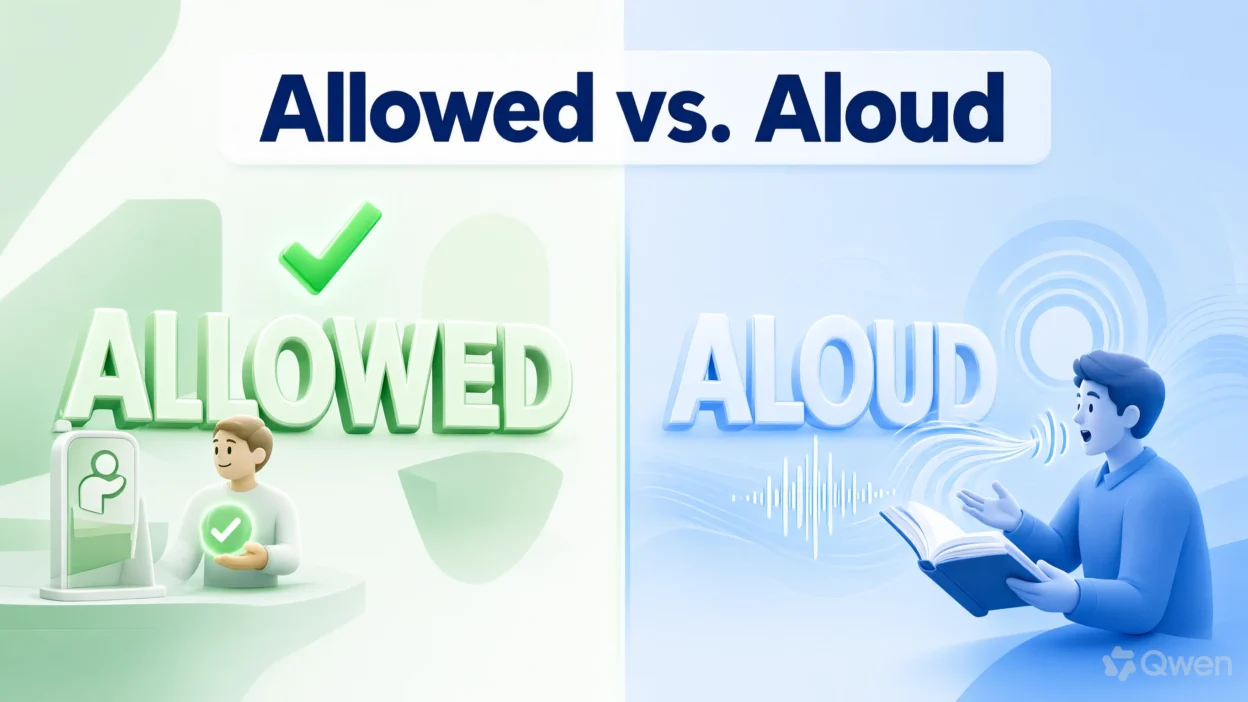
The words allowed and aloud sound exactly the same, but they have completely different meanings, spellings, and uses in English. If you are unsure If to write “You are allowed to leave” or “You are aloud to leave,” understanding the difference will help you avoid a common spelling and grammar mistake.
Allowed means permitted, authorized, or given permission to do something. Aloud means speaking audibly, using your voice so that someone can hear you. Although these words are homophones, they cannot be used interchangeably because they express different ideas.
English learners, students, and writers often confuse these words because their pronunciation is identical. In this guide, you will learn the meaning of allowed and aloud, their grammatical roles, when to use each word, common mistakes, and easy examples to help you remember the difference in everyday English.
Quick Answer: Allowed or Aloud?
Allowed means permitted or given permission to do something, while aloud means spoken out loud or audibly. Use allowed when discussing rules, permission, or freedom to do something. Use aloud when describing someone speaking or reading so their words can be heard. For example, “You are allowed to read aloud.”
Why Do People Confuse Allowed and Aloud?
People confuse allowed and aloud because they are homophones. Homophones are words that sound the same but have different meanings, spellings, and sometimes different grammatical functions.
When spoken, there is no noticeable difference between allowed and aloud in standard English pronunciation. However, their meanings become clear when you see them in a sentence.
The confusion is especially common in:
- School assignments and essays
- Text messages and online conversations
- English grammar exercises
- Dictation and speech-to-text writing
- Everyday sentences involving permission or speaking
The easiest way to avoid mistakes is to remember that allowed relates to permission, while aloud relates to sound or speaking.
1. What Does Allowed Mean?
Allowed means permitted, authorized, or given the right to do something. It is the past tense and past participle of the verb allow, which means to let someone do something or to give permission.
It is commonly used when discussing rules, restrictions, rights, instructions, and personal freedom.
Examples of Allowed in Sentences
- Students are allowed to use calculators during the exam.
- You are not allowed to park here.
- My parents allowed me to go to the party.
- Children are allowed to play outside.
- We were allowed to enter the building.
- Employees are allowed to take breaks.
- She is allowed to travel alone.
When to Use Allowed
Use allowed when talking about:
- Permission to do something.
- Rules and regulations.
- Something that is permitted or acceptable.
- Someone giving another person permission.
- Restrictions or freedom.
Allowed in Different Sentence Structures
1. Be allowed to + verb
This structure means someone has permission to do something.
- I am allowed to drive.
- She is allowed to use her phone.
- They were allowed to leave early.
2. Allow someone to + verb
This structure describes giving permission to another person.
- My teacher allows us to ask questions.
- The manager allowed him to take a day off.
- Her parents allow her to stay up late.
3. Not allowed
This structure expresses prohibition or a lack of permission.
- Visitors are not allowed inside.
- You are not allowed to smoke here.
- Students are not allowed to cheat.
2. What Does Aloud Mean?
Aloud means speaking audibly or using your voice so that other people can hear what you are saying. It is an adverb that describes how an action is performed.
It is commonly used with verbs such as read, say, speak, laugh, and think when describing something expressed out loud.
Examples of Aloud in Sentences
- She read the story aloud.
- He said the answer aloud.
- Please speak aloud so everyone can hear you.
- The teacher asked us to read aloud.
- I accidentally laughed aloud during the meeting.
- They repeated the words aloud.
- He was thinking aloud while solving the problem.
When to Use Aloud
Use aloud when describing:
- Reading with your voice instead of silently.
- Speaking so others can hear.
- Saying words out loud.
- Expressing thoughts verbally.
- Laughing audibly.
Aloud in Different Sentence Structures
1. Read aloud
- She read the letter aloud.
- I like reading stories aloud to children.
2. Say something aloud
- He said my name aloud.
- I repeated the instructions aloud.
3. Think aloud
- The teacher thought aloud while solving the math problem.
- I sometimes think aloud when making decisions.
In each example, aloud describes an audible action.
Allowed vs Aloud: Comparison Table
| Feature | Allowed | Aloud |
| Meaning | Permitted or authorized | Spoken audibly |
| Word type | Verb form / participle | Adverb |
| Root word | Allow | Loud |
| Usage | Permission and rules | Speaking and sounds |
| Pronunciation | /əˈlaʊd/ | /əˈlaʊd/ |
| Example | You are allowed to enter. | Read the passage aloud. |
| Related phrase | Be allowed to | Read aloud |
The biggest difference is their meaning. Allowed is about whether someone has permission, while aloud is about whether something is spoken audibly.
When to Use Allowed vs Aloud
Choosing the right word depends on the meaning of your sentence.
When to Use Allowed
Use allowed when you are talking about permission, rules, or something someone is permitted to do.
Examples:
- Are we allowed to bring food?
- He is allowed to use the computer.
- Photography is not allowed here.
- They allowed us to enter the room.
- You are allowed to ask questions.
If your sentence is about permission, allowed is usually the correct choice.
When to Use Aloud
Use aloud when someone is speaking, reading, laughing, or expressing something audibly.
Examples:
- Read the instructions aloud.
- She whispered the answer aloud.
- He counted aloud.
- The children sang aloud.
- I read the poem aloud to my classmates.
If your sentence is about making sounds or speaking so someone can hear, aloud is the correct word.
15 Examples of Allowed and Aloud in Sentences
Here are 15 practical examples to help you understand how to use these words correctly.
Examples Using Allowed
- We are allowed to use the library after school.
- My parents allowed me to visit my friend.
- Students are not allowed to talk during the exam.
- She was allowed to choose her own clothes.
- Are children allowed to watch this movie?
- They allowed us to stay for another hour.
- You are allowed to take photographs here.
- Employees are allowed to work from home.
Examples Using Aloud
- She read the book aloud to her brother.
- Please say your name aloud.
- He laughed aloud at the funny joke.
- The students read the poem aloud.
- I repeated the sentence aloud.
- She spoke her thoughts aloud.
- We counted the numbers aloud together.
These examples show that allowed refers to permission, while aloud describes audible speech or sounds.
Common Mistakes When Using Allowed and Aloud
Because allowed and aloud sound identical, writers sometimes choose the wrong spelling. Here are common mistakes to avoid.
| Incorrect Sentence | Correct Sentence |
| You are aloud to go outside. | You are allowed to go outside. |
| She read the book allowed. | She read the book aloud. |
| We are aloud to use phones. | We are allowed to use phones. |
| He spoke the answer allowed. | He spoke the answer aloud. |
| Are we aloud to enter? | Are we allowed to enter? |
Mistake 1: Using Aloud for Permission
Incorrect: You are aloud to play outside.
Correct: You are allowed to play outside.
Why? The sentence is about permission, so allowed is the correct word.
Mistake 2: Using Allowed for Speaking
Incorrect: She read the poem allowed.
Correct: She read the poem aloud.
Why? The sentence describes reading with a voice that can be heard, so aloud is needed.
Mistake 3: Confusing Allowed With Allow
Incorrect: My parents allowed me to goes outside.
Correct: My parents allowed me to go outside.
Why? After allow someone to, use the base form of the verb, such as go, eat, play, or study.
Easy Memory Trick to Remember Allowed vs Aloud
Here is a simple trick to remember these two words.
ALLOWED = Permission
Think about rules, freedom, and what you are permitted to do.
Example: I am allowed to drive.
ALOUD = Loud Voice
Think about saying something so that people can hear it.
Example: Read the sentence aloud.
Quick Memory Examples
- Allowed to go = Permission to go.
- Read aloud = Read using your voice.
- Not allowed = Not permitted.
- Say aloud = Speak audibly.
You can also remember that aloud contains the word loud. This connection makes it easier to associate aloud with speaking and sound.
Allowed vs Aloud in American and British English
There is no difference in the meaning or spelling of allowed and aloud in American and British English.
Both varieties use:
- Allowed to mean permitted or authorized.
- Aloud to mean spoken audibly.
Examples in American English:
- You are allowed to leave early.
- Please read the paragraph aloud.
Examples in British English:
- You are allowed to leave early.
- Please read the paragraph aloud.
The spelling, pronunciation, and grammatical usage are essentially the same in both varieties.
Similar Words Related to Allowed and Aloud
Learning similar words can help you expand your vocabulary and understand these terms more clearly.
| Word | Meaning | Example |
| Permitted | Given permission | Visitors are permitted inside. |
| Authorized | Officially approved | He is authorized to sign. |
| Approved | Accepted or agreed to | The plan was approved. |
| Forbidden | Not permitted | Smoking is forbidden here. |
| Prohibited | Officially not allowed | Parking is prohibited. |
| Audible | Able to be heard | Her voice was audible. |
| Loudly | With a high volume | He spoke loudly. |
| Verbally | Using spoken words | She explained it verbally. |
| Whisper | Speak very quietly | He whispered a secret. |
| Announce | Say something publicly | They announced the results. |
These words are related to permission, speaking, sound, or communication, but they are not always interchangeable with allowed or aloud.
Final Verdict: Allowed or Aloud?
Both allowed and aloud are correct English words, but they have completely different meanings.
Use allowed when talking about permission, rules, or something someone is permitted to do.
Example: You are allowed to use your laptop.
Use aloud when describing speaking, reading, or making a sound that can be heard.
Example: Read the sentence aloud.
If you are discussing whether someone has permission, choose allowed. If you are discussing someone speaking or reading audibly, choose aloud. Remembering these simple differences will help you avoid spelling mistakes and write more accurately.
FAQs:
1. Is It Allowed or Aloud?
Both words are correct, but their meanings are different. Allowed means permitted, while aloud means spoken audibly. For example, “You are allowed to enter” refers to permission, while “Read aloud” means read using your voice.
2. What Does Allowed Mean?
Allowed means permitted, authorized, or given permission to do something. It is the past tense and past participle of allow. For example, “Students are allowed to use calculators during the test.”
3. What Does Aloud Mean?
Aloud means speaking or reading audibly so that someone can hear. For example, “She read the story aloud.” It is commonly used with verbs such as read, speak, say, laugh, and think.
4. Is Aloud the Same as Out Loud?
Yes, aloud and out loud generally have the same meaning. Both describe something spoken so it can be heard. For example, “He read the letter aloud” and “He read the letter out loud” are both correct.
5. How Do You Use Allowed in a Sentence?
Use allowed when expressing permission or rules. For example, “We are allowed to bring our own lunch.” You can also use it with a person and an infinitive, as in “My teacher allowed me to leave early.”
6. Can Allowed and Aloud Be Used in the Same Sentence?
Yes, both words can be used in the same sentence because they have different meanings.
Example: “Students are allowed to read their answers aloud.”
Here, allowed means permitted, and aloud means speaking so the answers can be heard.
7. What Is the Opposite of Allowed?
Common opposites of allowed include forbidden, prohibited, banned, and not permitted. For example, “Smoking is not allowed here” can also be written as “Smoking is prohibited here.”
Remember This
- Allowed = Permitted or given permission.
- Aloud = Spoken audibly or out loud.
- Use allowed when discussing rules and freedom.
- Use aloud when describing speaking or reading.
- Allowed comes from the verb allow.
- Aloud is connected to the word loud.
- “You are allowed to read aloud” is a correct sentence containing both words.
Conclusion
Understanding the difference between allowed and aloud is easy when you focus on their meanings. Allowed is related to permission, rules, and authorization, while aloud describes something spoken or read so that it can be heard. Although these words sound identical, their grammatical roles and meanings are completely different.
The easiest way to remember them is to connect allowed with permission and aloud with a loud or audible voice. Whenever you write a sentence, ask yourself If you are talking about being permitted to do something or making sounds that others can hear. This simple trick will help you use the correct word confidently in conversations, essays, emails, and everyday writing.