The words allude and elude look similar and have nearly identical pronunciations, but they have completely different meanings. If you have ever confused allude with elude while writing an essay, speaking English, or preparing for an exam, understanding their difference will help you choose the right word every time.
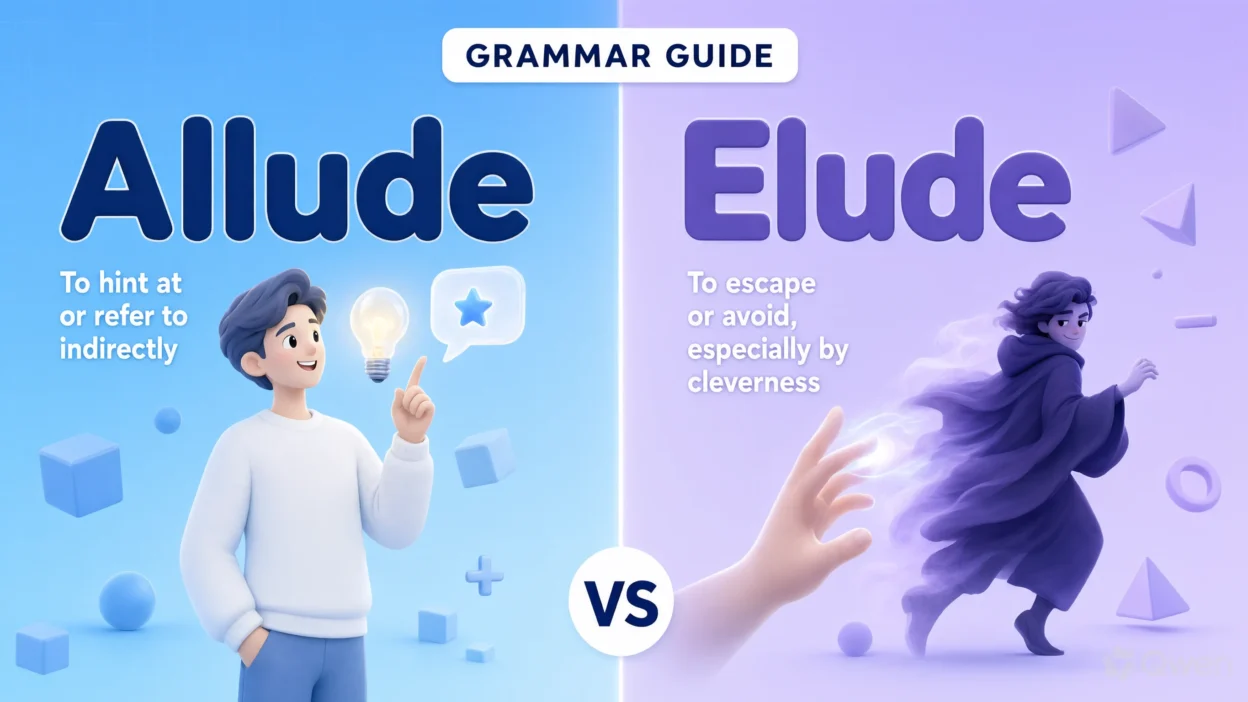
Allude means to refer to something indirectly or hint at it without mentioning it clearly or directly. Elude means to escape from, avoid, or remain difficult to understand, find, or catch. Although both words are commonly confused because of their similar spelling, they describe two very different actions.
In this guide, you will learn the meanings of allude and elude, their grammatical differences, when to use each word, common mistakes, practical sentence examples, and easy memory tricks. Whether you are a student, English learner, writer, or simply trying to improve your vocabulary, these explanations will help you use both words with confidence.
Quick Answer: Allude or Elude?
Allude means to hint at or refer to something indirectly, while elude means to escape, avoid, or remain difficult to grasp. For example, “She alluded to her past” means she mentioned it indirectly, whereas “The answer eluded her” means she could not find or understand the answer.
Why Do People Confuse Allude and Elude?
People confuse allude and elude because they have similar spellings, nearly identical sounds, and the same number of letters. Both words begin with the letter A or E, contain lude at the end, and are sometimes encountered in advanced writing.
However, their meanings are unrelated.
- Allude is connected to mentioning, hinting, or referring to something.
- Elude is connected to escaping, avoiding, or being difficult to catch or understand.
One word involves communication, while the other involves escape or difficulty.
Understanding the meaning behind each word is the easiest way to avoid confusing them.
1. What Does Allude Mean?
Allude is a verb that means to refer to something indirectly, without openly or explicitly stating it. When someone alludes to something, they give a hint or make a reference that the listener is expected to recognize.
An allusion may refer to a person, event, book, experience, idea, or something previously discussed.
Examples of Allude in Sentences
- She alluded to her difficult childhood during the interview.
- The author alludes to Shakespeare in his novel.
- He alluded to a possible change in company policy.
- The speaker alluded to an earlier disagreement.
- They alluded to the surprise party without revealing the details.
- Her comments alluded to problems within the organization.
- The movie alludes to several famous historical events.
When to Use Allude
Use allude when you want to describe:
- Referring to something without directly naming it.
- Giving a subtle hint about a subject.
- Mentioning an idea indirectly.
- Making a reference to literature, history, culture, or an earlier event.
Common Expressions With Allude
- Allude to something: Refer to something indirectly.
- Allude to a problem: Hint that a problem exists.
- Allude to someone: Refer indirectly to a person.
- Allude to an event: Make an indirect reference to something that happened.
Examples:
- She alluded to the incident but did not explain it.
- The poem alludes to ancient mythology.
- He alluded to his plans for the future.
Notice that allude is commonly followed by the preposition to.
2. What Does Elude Mean?
Elude is a verb that means to escape from someone or something, avoid being caught, or remain difficult to find, understand, remember, or achieve.
It can describe a physical escape as well as an abstract difficulty.
Examples of Elude in Sentences
- The thief eluded the police.
- The answer eluded me during the examination.
- She managed to elude her pursuers.
- The meaning of the poem eluded him.
- Success eluded the team for several years.
- The solution continues to elude scientists.
- His name eluded me for a moment.
When to Use Elude
Use elude when describing:
- Escaping from someone who is chasing you.
- Avoiding capture or detection.
- Something that is difficult to understand.
- A memory or name you cannot recall.
- A goal or success that remains difficult to achieve.
Common Expressions With Elude
- Elude capture: Avoid being caught.
- Elude the police: Escape from law enforcement.
- Elude understanding: Remain difficult to understand.
- Elude memory: Be difficult to remember.
- Elude success: Remain difficult to achieve.
Examples:
- The suspect eluded capture for weeks.
- The answer eluded the students.
- A sense of happiness seemed to elude him.
Unlike allude, the word elude does not require the preposition to in these common constructions.
Allude vs Elude: Comparison Table
| Feature | Allude | Elude |
| Part of speech | Verb | Verb |
| Meaning | Refer to something indirectly | Escape or avoid something |
| Main idea | Hint or reference | Escape or difficulty |
| Common usage | Allude to an idea | Elude the police |
| Related word | Allusion | Elusive |
| Example | He alluded to his past. | The answer eluded him. |
| Typical context | Communication or reference | Escape, memory, understanding, success |
Difference Between Allude and Elude at a Glance
- Allude = Hint at something.
- Elude = Escape from something or remain out of reach.
If someone alludes to a secret, they hint that it exists without revealing it. If a secret eludes someone, they cannot discover it.
When to Use Allude vs Elude
The best way to choose between these words is to consider what is happening in your sentence.
When to Use Allude
Use allude when someone is indirectly mentioning or referring to something.
Examples:
- The politician alluded to the recent controversy.
- She alluded to her previous experience.
- The author alludes to Greek mythology.
- He alluded to the answer but never explained it.
Ask yourself: Is someone hinting at or referring to something?
If yes, allude is probably the correct word.
When to Use Elude
Use elude when someone escapes, avoids something, or cannot grasp or achieve something.
Examples:
- The criminal eluded the guards.
- The correct answer eluded me.
- A peaceful life seemed to elude him.
- The meaning of the sentence eluded the reader.
Ask yourself: Is something escaping, avoiding, or remaining difficult to catch, find, understand, or achieve?
If yes, elude is probably the correct word.
15 Examples of Allude and Elude in Sentences
These examples will help you understand the difference in real-life situations.
Examples Using Allude
- The teacher alluded to the upcoming examination.
- He alluded to his childhood memories in the speech.
- The writer alludes to a famous historical event.
- She alluded to her disagreement without saying it directly.
- The advertisement alludes to a popular movie.
- They alluded to their future plans during dinner.
- His remarks alluded to the ongoing investigation.
- The poem alludes to themes of love and loss.
Examples Using Elude
- The fox eluded the hunters.
- The answer eluded me during the quiz.
- She eluded the reporters by leaving through another exit.
- The meaning of the passage eluded many readers.
- Peace seemed to elude the troubled country.
- The suspect eluded capture for several days.
- His name eluded me until my friend reminded me.
These sentences show that allude is used for indirect references, while elude describes escape or something that remains out of reach.
Common Mistakes When Using Allude and Elude
Because these words look and sound similar, writers often use one when they actually mean the other.
| Incorrect Usage | Correct Usage |
| He eluded to his childhood. | He alluded to his childhood. |
| She alluded the police. | She eluded the police. |
| The answer alluded me. | The answer eluded me. |
| He eluded to the problem. | He alluded to the problem. |
| The thief alluded capture. | The thief eluded capture. |
Mistake 1: Using Elude When You Mean Hint
Incorrect: She eluded to her secret.
Correct: She alluded to her secret.
Why? She is indirectly referring to something, so alluded is the correct verb.
Mistake 2: Using Allude When You Mean Escape
Incorrect: The criminal alluded the police.
Correct: The criminal eluded the police.
Why? The criminal escaped or avoided being caught, so eluded is correct.
Mistake 3: Confusing Allude With Mention
Allude does not usually mean to mention something directly. It means to refer to it indirectly.
- Direct: She mentioned her divorce.
- Indirect: She alluded to her divorce.
If someone clearly states something, mention may be more appropriate. If they hint at it without explaining fully, allude is the better choice.
Easy Memory Trick to Remember Allude vs Elude
Here is a simple trick to remember the difference between these two words.
ALLUDE = A reference
Think of ALLUDE as referring to or hinting at something without saying it directly.
She alluded to her secret.
ELUDE = Escape
Think of ELUDE as escaping, avoiding, or remaining out of reach.
The answer eluded him.
One-Sentence Memory Trick
Allude to an idea, but elude a capture or an answer.
This simple phrase can help you remember the correct word whenever you are writing or speaking.
Allude vs Elude in American and British English
There is no difference between American and British English in the spelling, meaning, or grammatical use of allude and elude.
Both varieties use:
- Allude to refer to something indirectly.
- Elude to escape, avoid, or remain difficult to understand.
Examples in American English
- He alluded to the previous meeting.
- The answer eluded her.
Examples in British English
- He alluded to the previous meeting.
- The answer eluded her.
Both words are spelled the same and used in the same way in American and British English. There is no regional spelling variation to remember.
Similar Words Related to Allude and Elude
Learning related words can help you understand these verbs more clearly and expand your vocabulary.
| Word | Meaning | Example |
| Allusion | An indirect reference | The novel contains a biblical allusion. |
| Refer | Direct attention to something | She referred to the report. |
| Hint | Suggest something indirectly | He hinted at a surprise. |
| Imply | Suggest something without stating it directly | Her tone implied disappointment. |
| Mention | Talk about something briefly | He mentioned the meeting. |
| Elusive | Difficult to find, catch, or understand | The answer was elusive. |
| Escape | Get away from something | The prisoner escaped. |
| Evade | Avoid or escape something | She evaded the question. |
| Avoid | Stay away from something | He avoided the conflict. |
| Slip away | Leave quietly or unnoticed | The thief slipped away. |
Allude, Refer, and Imply
These words are related but have slightly different meanings.
- Allude: Refer to something indirectly.
- Refer: Direct attention to something, either directly or indirectly.
- Imply: Suggest a meaning without stating it openly.
Elude, Evade, and Escape
These words are also related but are not always interchangeable.
- Elude: Escape from something or remain difficult to grasp.
- Evade: Deliberately avoid something, such as a question, responsibility, or pursuer.
- Escape: Get away from a place, person, or situation.
Understanding these related words can help you choose more precise vocabulary in everyday writing.
Final Verdict: Allude or Elude?
Both allude and elude are correct English words, but they have different meanings and should not be used interchangeably.
Use allude when someone hints at, indirectly mentions, or refers to something. Use elude when someone escapes, avoids being caught, or when something remains difficult to find, remember, understand, or achieve.
For example, “She alluded to the problem” means she hinted at the problem, while “The solution eluded her” means she could not find the solution.
Remember this simple distinction: allude means hint, while elude means escape. Learning this difference will make your writing more accurate and help you avoid a common English vocabulary mistake.
FAQs:
1. What Is the Difference Between Allude and Elude?
Allude means to refer to something indirectly or hint at it, while elude means to escape, avoid, or remain difficult to understand or find. For example, “He alluded to the mistake” and “The answer eluded him” have different meanings.
2. Is It Allude to or Elude to?
The correct expression is generally allude to when you mean indirectly referring to something. For example, “She alluded to her previous experience.” Elude normally does not take to in this meaning. You would say “The answer eluded me,” not “The answer eluded to me.”
3. What Does Allude Mean in Simple Words?
Allude means to hint at something or mention it indirectly without explaining it clearly. For example, if someone talks about a difficult experience without describing exactly what happened, they are alluding to that experience.
4. What Does Elude Mean in Simple Words?
Elude means to escape, avoid, or be difficult to catch, find, remember, or understand. For example, “The name eluded me” means I could not remember the name at that moment.
5. Can Allude and Elude Be Used Interchangeably?
No, allude and elude cannot be used interchangeably because they have different meanings. Allude relates to indirect communication or reference, while elude relates to escape or something remaining out of reach.
6. What Is the Past Tense of Allude and Elude?
Both verbs form their simple past tense and past participle by adding -ed.
- Allude → Alluded → Alluded
- Elude → Eluded → Eluded
Examples:
- She alluded to the issue yesterday.
- The criminal eluded the guards.
7. What Is the Difference Between Allude and Illude?
Allude is a common English verb meaning to refer to something indirectly. Illude is a rare word associated with deceiving or misleading, but it is uncommon in everyday English. Most writers need allude, not illude, when referring to an indirect hint or reference.
Remember This
- Allude = Hint at or refer to something indirectly.
- Elude = Escape, avoid, or remain difficult to grasp.
- Allude to = The common expression for making an indirect reference.
- Elude capture = Escape from being caught.
- Alluded = Past tense of allude.
- Eluded = Past tense of elude.
- Allude relates to communication; elude relates to escape or difficulty.
Conclusion
Understanding the difference between allude and elude becomes easy when you focus on their meanings rather than their similar spellings. Allude is used when someone indirectly refers to something, hints at an idea, or makes a subtle reference. Elude is used when someone escapes, avoids being caught, or when something remains difficult to understand, find, or achieve.
The best way to remember these words is to associate allude with hints and references and elude with escape. Practice using both words in your own sentences, such as “He alluded to the disagreement” and “The answer eluded him.” With a little practice, you will be able to use both words naturally and confidently in everyday English.

Lucas Smith is a skilled language writer at Synomity.com, passionate about synonyms, vocabulary enrichment, and word meanings. He develops engaging content that helps readers strengthen communication skills and expand their understanding of language.