The words aisle, isle, and I’ll sound almost identical when spoken, but they have completely different meanings, spellings, and grammatical uses. These words can easily confuse English learners, students, and writers because their pronunciation is similar, even though they refer to different things. Knowing which word to use will help you avoid spelling mistakes and make your sentences clearer.
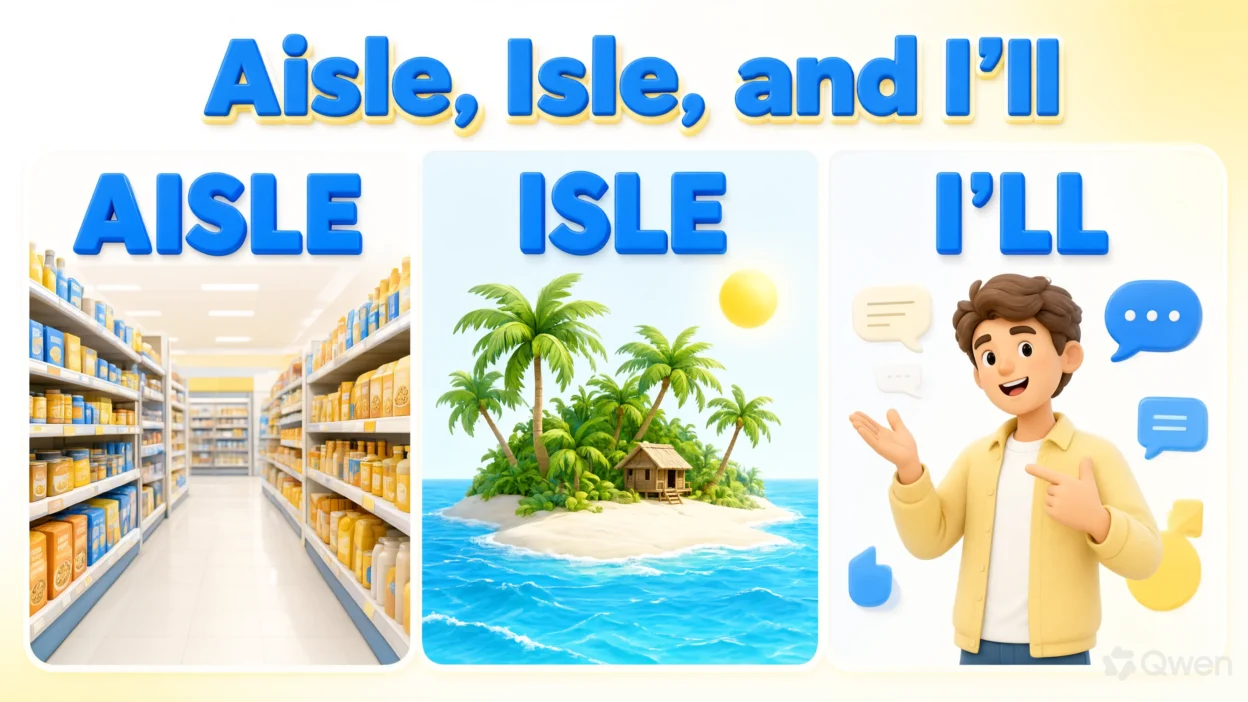
Aisle refers to a passage or walkway between rows of seats, shelves, or other objects. Isle means an island or a piece of land surrounded by water. I’ll is a contraction of “I will” or “I shall,” used when talking about the future or making promises, decisions, and predictions.
In this guide, you will learn the meanings of aisle, isle, and I’ll, how they differ, when to use each one, and how to remember their correct spelling. You will also find easy examples, common mistakes, and answers to frequently asked questions.
Quick Answer: Aisle, Isle, or I’ll?
Aisle means a walkway between rows, such as in a supermarket, airplane, or theater. Isle means an island or a piece of land surrounded by water. I’ll is the contraction of “I will” or “I shall,” used to express future actions, promises, or decisions. Although they sound alike, their meanings are completely different.
Why Do People Confuse Aisle, Isle, and I’ll?
People confuse these three words because they are homophones, meaning they have the same or nearly identical pronunciation but different spellings and meanings.
In most standard English accents, aisle, isle, and I’ll are pronounced /aɪl/, like the word “eye” followed by an “l” sound.
Since you cannot easily distinguish them by listening, you must understand the context of the sentence to choose the correct spelling.
For example:
- Walk down the aisle. (A walkway)
- Visit the beautiful isle. (An island)
- I’ll call you tomorrow. (I will)
The meaning of the sentence tells you which word is correct.
1. What Does Aisle Mean?
Aisle is a noun that means a passage or walkway between rows of seats, shelves, people, or other objects. It allows people to walk through an area without moving everything around them.
You commonly see aisles in supermarkets, airplanes, churches, theaters, libraries, and large stores.
75 ventes par seconde : ce produit a écrasé tous les records en supermarché en 2025
Examples of Aisle in Sentences
- I walked down the grocery aisle to find milk.
- Please keep the airplane aisle clear.
- The bride walked down the aisle with her father.
- He found the book in the middle aisle of the library.
- The children sat beside the aisle in the theater.
- She left her shopping cart in the aisle.
When to Use Aisle
Use aisle when talking about:
- A passage between supermarket shelves.
- A walkway between rows of seats.
- A path through a church, theater, or airplane.
- A space that allows people to move between rows.
Common Phrases With Aisle
- Grocery aisle: A passage between supermarket shelves.
- Center aisle: A walkway in the middle of a seating area.
- Wedding aisle: The walkway where the bride or wedding party walks.
- Aisle seat: A seat next to a walkway.
- Walk down the aisle: A phrase commonly associated with getting married.
Example: I prefer an aisle seat because I can get up easily during the flight.
2. What Does Isle Mean?
Isle is a noun that means an island or a piece of land surrounded by water. It is often used in the names of islands and in literary or geographical descriptions.
The word isle is closely related to island, but it often sounds more poetic or appears in traditional place names.
Examples of Isle in Sentences
- They spent their vacation on a peaceful isle.
- The tiny isle was surrounded by blue water.
- We visited the Isle of Man last summer.
- The sailors discovered a remote isle.
- She dreamed of living on a tropical isle.
- The castle stood on a rocky isle.
When to Use Isle
Use isle when talking about:
- An island surrounded by water.
- A small or picturesque island.
- A geographical location with isle in its name.
- Island settings in travel writing, literature, or descriptive language.
Common Phrases With Isle
- Desert isle: An isolated island, often imagined as a place of escape.
- Tropical isle: An island in a tropical region.
- Isle of Man: A self-governing British Crown Dependency located in the Irish Sea.
- Isle of Wight: An island off the southern coast of England.
- Emerald Isle: A poetic nickname for Ireland.
Example: We spent three days exploring a beautiful tropical isle.
3. What Does I’ll Mean?
I’ll is a contraction of I will or, in some contexts, I shall. It is a pronoun combined with a helping verb and is commonly used to express future actions, promises, willingness, decisions, or predictions.
The apostrophe replaces the missing letters in will or shall.
Examples of I’ll in Sentences
- I’ll call you when I arrive.
- I’ll help you with your homework.
- I’ll visit my grandmother tomorrow.
- I’ll bring some food to the party.
- I’ll finish the project tonight.
- I’ll never forget your kindness.
When to Use I’ll
Use I’ll when:
- Talking about future actions.
- Making promises.
- Offering help.
- Expressing willingness.
- Making spontaneous decisions.
- Predicting something.
Common Phrases With I’ll
- I’ll be there: A promise or statement about arriving.
- I’ll help you: An offer of assistance.
- I’ll try: A statement of willingness.
- I’ll see you later: A future meeting.
- I’ll take it: A decision or choice.
Example: Don’t worry about the bags. I’ll carry them for you.
Aisle vs Isle vs I’ll: Comparison Table
| Word | Part of Speech | Meaning | Example |
| Aisle | Noun | A passage or walkway between rows | Walk through the aisle. |
| Isle | Noun | An island surrounded by water | They visited a peaceful isle. |
| I’ll | Contraction | I will or I shall | I’ll see you tomorrow. |
Although these words sound alike, their meanings are easy to identify when you pay attention to the sentence.
When to Use Aisle, Isle, and I’ll
Choosing the correct word becomes easier when you think about what the sentence is describing.
When to Use Aisle
Use aisle when the sentence refers to a walkway or passage.
Examples:
- The supermarket aisle was crowded.
- He walked down the aisle.
- I booked an aisle seat on the plane.
Ask yourself: Is this sentence talking about a walkway? If yes, use aisle.
When to Use Isle
Use isle when the sentence refers to an island or land surrounded by water.
Examples:
- They stayed on a beautiful isle.
- The small isle was home to many birds.
- We sailed around the isle.
Ask yourself: Is this sentence talking about an island? If yes, use isle.
When to Use I’ll
Use I’ll when you mean I will or I shall.
Examples:
- I’ll complete the task tomorrow.
- I’ll bring you some coffee.
- I’ll explain everything later.
Ask yourself: Can I replace this word with “I will”? If yes, use I’ll.
15 Examples of Aisle, Isle, and I’ll in Sentences
Here are 15 simple examples to help you understand the difference.
Examples Using Aisle
- She walked through the narrow aisle.
- I found the cereal in the breakfast aisle.
- Please leave your bags out of the airplane aisle.
- He chose an aisle seat for the journey.
- The bride walked down the aisle.
Examples Using Isle
- They visited a beautiful isle during their vacation.
- The remote isle had no electricity.
- We sailed toward the mysterious isle.
- The island was a peaceful isle surrounded by nature.
- The Isle of Wight is a popular holiday destination.
Examples Using I’ll
- I’ll call you after dinner.
- I’ll finish my homework before bedtime.
- I’ll help you clean the house.
- I’ll buy some groceries on my way home.
- I’ll always remember this special day.
These examples show how context determines which spelling you should use.
Common Mistakes With Aisle, Isle, and I’ll
Because these words sound alike, spelling mistakes are common. Here are some errors you should avoid.
| Incorrect Sentence | Correct Sentence |
| Walk down the isle of the store. | Walk down the aisle of the store. |
| We visited a beautiful aisle. | We visited a beautiful isle. |
| Isle call you tomorrow. | I’ll call you tomorrow. |
| The bride walked down the isle. | The bride walked down the aisle. |
| I’ll visit the tropical aisle. | I’ll visit the tropical isle. |
Mistake 1: Using Isle for a Walkway
Incorrect: I walked through the supermarket isle.
Correct: I walked through the supermarket aisle.
Why? A walkway between shelves is an aisle, not an isle.
Mistake 2: Using Aisle for an Island
Incorrect: They visited a remote aisle.
Correct: They visited a remote isle.
Why? A piece of land surrounded by water is an isle.
Mistake 3: Using Isle Instead of I’ll
Incorrect: Isle bring your book tomorrow.
Correct: I’ll bring your book tomorrow.
Why? When expressing a future action or promise, use I’ll, meaning I will.
Easy Memory Trick to Remember Aisle, Isle, and I’ll
Here is a simple trick to remember these three words without getting confused.
AISLE = A walkway
Think of supermarket shelves and the space between them where you walk.
ISLE = Island
Both isle and island refer to land surrounded by water. Remember that isle is a shorter word for an island.
I’LL = I will
Whenever you can replace the word with I will, use I’ll.
Quick Memory Examples
- Aisle → Walkway → Walk down the aisle.
- Isle → Island → Visit a tropical isle.
- I’ll → I will → I’ll call you later.
Remembering these three simple connections will help you choose the correct word every time.
Aisle vs Isle vs I’ll in American and British English
There is no meaningful spelling or usage difference between these three words in standard American and British English.
Both varieties use:
- Aisle for a passage or walkway.
- Isle for an island.
- I’ll as a contraction of I will or I shall.
American English Examples
- Walk down the aisle.
- They visited a beautiful isle.
- I’ll call you tomorrow.
British English Examples
- Walk down the aisle.
- They visited a beautiful isle.
- I’ll call you tomorrow.
The spelling and meanings remain the same in both varieties. Their pronunciation may vary slightly depending on a speaker’s accent, but they are generally homophones.
Similar Words Related to Aisle, Isle, and I’ll
Learning similar words can help improve your vocabulary and prevent confusion.
| Word | Meaning | Example |
| Island | Land surrounded by water | They live on an island. |
| Passage | A way through or between places | The passage was narrow. |
| Corridor | A hallway connecting rooms | Walk down the corridor. |
| Walkway | A path for walking | Stay on the walkway. |
| Lane | A narrow path or route | Drive in the left lane. |
| I’ll | I will or I shall | I’ll help you. |
| We’ll | We will | We’ll leave soon. |
| You’ll | You will | You’ll enjoy it. |
| He’ll | He will | He’ll arrive soon. |
| She’ll | She will | She’ll call later. |
These words are useful in everyday communication and can help you understand sentence meaning more clearly.
Final Verdict: Aisle, Isle, or I’ll?
The correct word depends entirely on what you mean.
Use aisle when talking about a passage or walkway between rows, such as in a supermarket, airplane, church, or theater.
Use isle when referring to an island or a piece of land surrounded by water.
Use I’ll when you mean I will or I shall, especially when talking about future actions, promises, offers, or decisions.
Although all three words sound alike, their meanings are completely different. Remembering their definitions and paying attention to context will help you use them correctly in everyday English.
FAQs:
1. What Is the Difference Between Aisle, Isle, and I’ll?
Aisle means a walkway between rows, isle means an island, and I’ll is a contraction of I will or I shall. They sound alike but have different meanings, spellings, and grammatical functions.
2. Is Aisle or Isle Correct?
Both words are correct, but they have different meanings. Aisle refers to a passage or walkway, while isle refers to an island. The correct choice depends on the context of your sentence.
3. What Does I’ll Stand For?
I’ll stands for I will or I shall. It is commonly used when talking about future actions, making promises, offering help, or expressing willingness. For example, “I’ll help you” means “I will help you.”
4. Is Aisle a Homophone of Isle?
Yes. Aisle and isle are homophones because they are pronounced the same way but have different spellings and meanings. I’ll is also generally pronounced the same way, making all three words homophones in most standard English accents.
5. How Do You Use Isle in a Sentence?
Use isle when referring to an island or a piece of land surrounded by water. For example, “They spent their vacation on a beautiful tropical isle.” It is also used in geographical names such as the Isle of Man.
6. How Do You Use Aisle in a Sentence?
Use aisle when referring to a passage or walkway between rows of seats, shelves, or other objects. For example, “She walked down the grocery aisle to find milk.”
7. Can I Use I’ll in Formal Writing?
Yes. I’ll is grammatically correct and widely accepted in everyday and professional writing. However, in very formal academic or legal writing, you may prefer the full form I will depending on the tone and context.
Remember This
- Aisle = A passage or walkway between rows.
- Isle = An island surrounded by water.
- I’ll = I will or I shall.
- Use aisle for supermarket, airplane, church, and theater walkways.
- Use isle for islands and geographical places.
- Use I’ll for future actions, promises, offers, and decisions.
- Remember: Aisle = Walkway, Isle = Island, I’ll = I Will.
Conclusion
Understanding the difference between aisle, isle, and I’ll is easy when you focus on their meanings instead of their pronunciation. Although these words sound alike, they serve completely different purposes in English. Aisle describes a walkway, isle refers to an island, and I’ll expresses a future action or intention.
The easiest way to remember them is to connect each word with a familiar idea: an aisle is where you walk between rows, an isle is a piece of land surrounded by water, and I’ll means I will. With these simple definitions and examples, you can avoid common spelling mistakes and use all three words confidently in your writing.

John Morrison is a dedicated content writer at Synomity.com, focused on synonyms, vocabulary development, and word meanings. He creates clear, educational resources that help readers improve language skills and communicate with confidence.