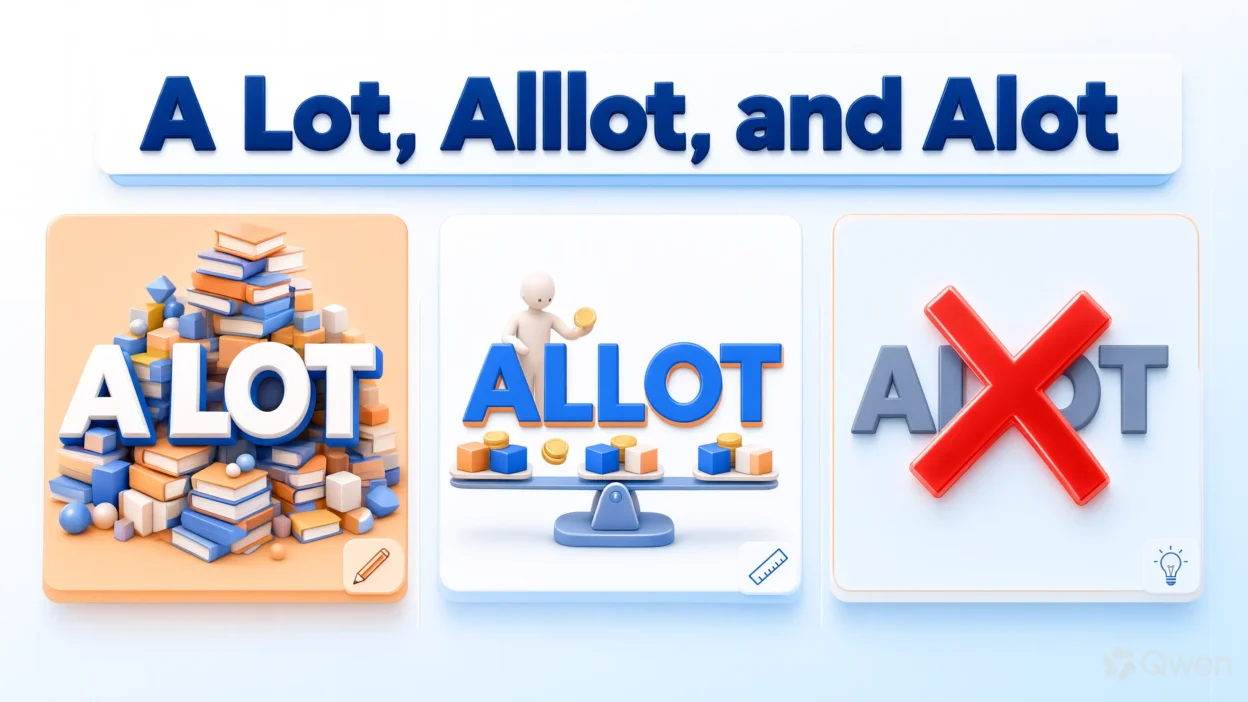
The words a lot, allot, and alot look and sound similar, but they have very different meanings and grammatical uses. If you have ever wondered whether to write “I have alot of work” or “I have a lot of work,” you are not alone. Many students, English learners, and even native speakers make this mistake when writing quickly.
The correct spelling for expressing a large quantity or degree is a lot, written as two separate words. Allot is a real English word, but it means to distribute, assign, or give something to someone. Meanwhile, alot is generally considered a misspelling and is not accepted in standard English writing.
Understanding these three forms will help you avoid spelling mistakes, improve your grammar, and write more confidently in school assignments, emails, essays, and everyday conversations. In this guide, you will learn their meanings, differences, correct usage, examples, and easy tricks to remember them.
Quick Answer: A Lot, Allot, or Alot?
A lot is the correct phrase for meaning many, much, or a large amount. Allot is a verb meaning to distribute, assign, or set aside something. Alot is a common spelling mistake; it is not accepted as a standard spelling in formal English. For example, write “I have a lot of homework,” not “I have alot of homework.”
Why Do People Confuse A Lot, Allot, and Alot?
People confuse these words because they look similar, sound almost identical, and are often used in informal writing, texting, and social media.
The main confusion comes from the fact that a lot is made up of two separate words, while allot is a single word with a completely different meaning. Since English contains many words formed by combining smaller words, writers sometimes assume that a lot should also be written as alot.
However, spelling matters when you want your writing to be clear and grammatically correct.
Here is the basic difference:
- A lot: A large number, amount, or degree.
- Allot: To distribute, assign, or give a specific amount.
- Alot: A common misspelling of a lot.
1. What Does A Lot Mean?
A lot is a phrase that means many, much, a large amount, or frequently, depending on the context. It is commonly used in everyday English to express quantity, degree, or frequency.
It can refer to countable nouns, uncountable nouns, or actions.
Examples of A Lot in Sentences
- I have a lot of friends.
- She drinks a lot of water.
- We learned a lot in class today.
- He travels a lot for work.
- There is a lot of food on the table.
- I love you a lot.
- They spend a lot of time together.
When to Use A Lot
Use a lot when you want to express:
- A large number of things: A lot of people attended the event.
- A large amount of something: She has a lot of money.
- A high degree: I like this book a lot.
- Frequent actions: He exercises a lot.
Is A Lot One Word or Two?
A lot is always written as two words when it means many, much, or a large amount.
Correct: We have a lot of work to do.
Incorrect: We have alot of work to do.
You can also use a lot without the word of when it modifies a verb or adjective.
- She smiles a lot.
- I enjoyed the movie a lot.
- He is a lot taller than me.
2. What Does Allot Mean?
Allot is a verb that means to distribute, assign, allocate, or give a particular amount of something to someone or for a specific purpose.
It is used when something is divided, planned, or assigned among people, activities, or tasks.
Examples of Allot in Sentences
- The teacher allotted ten minutes for the quiz.
- We allotted each student a seat.
- The manager allotted extra time for the meeting.
- They allotted a budget for the project.
- The government allotted land to the farmers.
- I allot one hour every day to studying English.
When to Use Allot
Use allot when you are talking about:
- Assigning time to an activity.
- Distributing resources among people.
- Giving someone a specific share.
- Setting aside money, space, or time for a purpose.
Allot Word Forms
The verb allot has several forms:
| Verb Form | Word |
| Base form | Allot |
| Simple past | Allotted |
| Past participle | Allotted |
| Present participle | Allotting |
| Third-person singular | Allots |
Examples:
- I allot 30 minutes to reading.
- She allotted extra time for homework.
- They have allotted seats to everyone.
- He is allotting funds for the new project.
Notice that allot doubles the final t when adding -ed or -ing.
3. What Does Alot Mean?
Alot is not a standard English word. It is a common spelling error made when people write a lot as one word.
Although you may see alot in text messages, comments, online posts, or casual writing, it is not considered correct in standard English.
Examples of Incorrect and Correct Usage
| Incorrect | Correct |
| I have alot of homework. | I have a lot of homework. |
| She likes me alot. | She likes me a lot. |
| We learned alot today. | We learned a lot today. |
| There are alot of books here. | There are a lot of books here. |
| He travels alot. | He travels a lot. |
Why Is Alot Incorrect?
The phrase a lot is made up of two separate words: the article a and the noun lot. Unlike words such as anyone or something, these two words have not combined into a standard single-word spelling for this meaning.
Therefore, when expressing quantity or degree, always write a lot, not alot.
A Lot vs Allot vs Alot: Comparison Table
| Word | Correct or Incorrect? | Meaning | Example |
| A lot | Correct | Many, much, or a large amount | I have a lot of books. |
| Allot | Correct | Assign or distribute something | They allot time for study. |
| Alot | Incorrect in standard English | Common spelling mistake | Write “a lot” instead. |
This table makes the difference easy to remember: a lot describes quantity, allot describes distribution, and alot should be avoided in standard writing.
When to Use A Lot, Allot, and Alot
Choosing the right word depends on what you want to say.
Use A Lot for Quantity or Degree
Use a lot when talking about many things, a large amount, or something happening frequently.
Examples:
- She has a lot of clothes.
- We eat vegetables a lot.
- I miss my family a lot.
- There is a lot of traffic today.
Use Allot for Assigning or Distributing
Use allot when giving someone a share of something or setting aside resources.
Examples:
- The teacher allotted five minutes for each question.
- The company allotted money for advertising.
- We allotted one room to each family.
- They allot time for daily exercise.
Avoid Alot in Standard English
Do not use alot in schoolwork, professional emails, essays, articles, or formal writing.
Instead, write:
- A lot of people came.
- I like this song a lot.
- She has a lot of experience.
15 Examples of A Lot, Allot, and Alot
Here are 15 examples to help you understand how these words work in everyday English.
Examples Using A Lot
- I have a lot of homework tonight.
- She reads a lot of books.
- We learned a lot from our teacher.
- He spends a lot of money on clothes.
- They travel a lot during the summer.
- There are a lot of students in the classroom.
- I enjoyed the party a lot.
- My brother talks a lot.
Examples Using Allot
- The teacher allotted 20 minutes for the test.
- We allotted space for the new library.
- The manager allotted tasks to the employees.
- They allotted money for the charity event.
- Each student was allotted a computer.
Examples of Alot (Incorrect Usage)
14. Incorrect: I have alot of friends.
Correct: I have a lot of friends.
15. Incorrect: She loves her family alot.
Correct: She loves her family a lot.
These examples show why choosing the correct spelling and meaning matters.
Common Mistakes With A Lot, Allot, and Alot
Many spelling mistakes happen because words sound similar or writers type them without checking. Here are some common errors to avoid.
| Common Mistake | Correct Usage |
| Writing alot of people | Writing a lot of people |
| Saying allot of money when meaning a large amount | Saying a lot of money |
| Writing I like it alot | Writing I like it a lot |
| Using a lot when meaning assign | Using allot |
| Writing allot of homework when meaning much homework | Writing a lot of homework |
Mistake 1: Writing Alot Instead of A Lot
Incorrect: She has alot of experience.
Correct: She has a lot of experience.
Why? The phrase a lot must be written as two words when it means a large quantity or degree.
Mistake 2: Using Allot Instead of A Lot
Incorrect: There are allot of students in the hall.
Correct: There are a lot of students in the hall.
Why? Allot means to assign or distribute something, not to describe a large number.
Mistake 3: Confusing Allot With Quantity
Incorrect: I allot of time for studying.
Correct: I spend a lot of time studying.
Correct: I allot one hour to studying.
Why? Allot requires an action of assigning or setting aside something, while a lot describes a large quantity.
Easy Memory Trick to Remember A Lot vs Allot
Here is a simple trick to help you remember the difference.
A LOT = A large amount
Think of the phrase a lot of things. Whenever you mean many, much, or a large amount, use two words.
ALLOT = Assign or Allocate
Think of allotting tasks, time, money, or space. Whenever you are distributing or assigning something, use allot.
ALOT = A spelling mistake
Remember that alot is not the correct standard spelling of a lot.
Quick Memory Examples
- A lot of homework = Much homework.
- Allot time = Assign time.
- Alot = Incorrect spelling.
If you remember these three meanings, you will rarely confuse the words again.
A Lot vs Allot in American and British English
There is no difference between American and British English in the standard spelling or meaning of a lot and allot.
Both American and British writers use:
- A lot to describe a large amount or degree.
- Allot to mean assign, distribute, or allocate.
- Alot as a nonstandard spelling error.
Examples in American English:
- I have a lot of work today.
- The teacher allotted extra time.
Examples in British English:
- I have a lot of work today.
- The teacher allotted extra time.
These words are spelled and used the same way in both varieties of English.
Similar Words Related to A Lot and Allot
Several other English words and phrases can help you express quantity or distribution more accurately.
| Word or Phrase | Meaning | Example |
| Many | A large number of countable things | Many students attended. |
| Much | A large amount of something | I don’t have much time. |
| Plenty | More than enough | We have plenty of food. |
| Numerous | A large number | Numerous people applied. |
| Several | More than two, but not many | I bought several books. |
| Allocate | Distribute resources for a purpose | They allocated funds for research. |
| Assign | Give someone a task | She assigned homework. |
| Distribute | Give something to several people | They distributed food. |
| Abundant | Available in large quantities | The region has abundant water. |
| Ample | Enough or more than enough | We have ample space. |
These alternatives can help make your writing more precise. Instead of repeating a lot many times, you can choose a word that better describes the quantity or situation.
Final Verdict: A Lot or Allot?
The correct choice depends on the meaning of your sentence.
Use a lot when you mean many, much, a large amount, or frequently. Use allot when you mean to assign, distribute, or set aside something for a particular purpose. Avoid alot, because it is a nonstandard spelling of a lot.
For example, “I have a lot of work” means you have much work to do, while “I allot two hours to work” means you assign two hours for that activity.
Remember that a lot is two words, allot is a verb, and alot is a spelling mistake. Once you understand these simple rules, choosing the correct word becomes easy.
FAQs:
1. Is A Lot One Word or Two?
A lot is two words. It is used to describe a large amount, many things, or a high degree. For example, “She has a lot of friends.” Writing alot as one word is incorrect in standard English.
2. Is Alot a Real Word?
Alot is not recognized as a standard English spelling. It is a common spelling mistake for a lot. In formal writing, academic work, emails, and professional communication, always write a lot as two words.
3. What Is the Difference Between A Lot and Allot?
A lot means many, much, or a large amount. Allot is a verb meaning to distribute, assign, or set aside something. For example, “I have a lot of work” describes quantity, while “I allot an hour for work” describes assigning time.
4. How Do You Use Allot in a Sentence?
Use allot when assigning or distributing something for a specific purpose. For example, “The teacher allotted 15 minutes for the activity.” It can also be used for money, space, resources, responsibilities, or time.
5. Is A Lot Formal or Informal?
A lot is acceptable in both everyday and many formal contexts, although more precise alternatives such as numerous, substantial, considerable, or many may be better in academic and professional writing.
6. Is Alot Correct in British English?
No. Alot is not the standard spelling in British English. British writers use a lot as two words, just like American writers. The meaning and spelling of a lot and allot are the same in both varieties.
7. What Is the Past Tense of Allot?
The simple past tense of allot is allotted. The past participle is also allotted, and the present participle is allotting.
Examples:
- She allotted extra time yesterday.
- They have allotted seats to the guests.
- He is allotting money for the project.
Remember This
- A lot = Many, much, or a large amount.
- Allot = Assign, distribute, or set aside.
- Alot = Incorrect spelling in standard English.
- Write a lot as two words.
- Use allot when giving someone a share of something.
- Use a lot when describing quantity, degree, or frequency.
- Remember: “A lot of things” but “allot time.”
Conclusion
Understanding the difference between a lot, allot, and alot is simple once you learn their meanings. A lot is the correct two-word phrase for expressing a large quantity or degree. Allot is a verb that means to assign, distribute, or set aside something. Alot is a common spelling mistake that should be avoided in standard English writing.
The best way to remember these words is to connect them with their purposes. Use a lot when describing quantity, allot when assigning something, and never use alot in formal or standard writing. With these simple rules and examples, you can write more clearly, avoid common spelling errors, and use English more confidently.